PSEB Solutions for Class 10 Maths Chapter 2 Polynomials Ex 2.2
Table of Contents
Introduction
PSEB Solutions for Class 10 Maths Chapter 2 Polynomials Exercise 2.2 is a comprehensive guide that provides step-by-step solutions to various problems related to polynomials. This guide is designed to help students understand the concepts and techniques involved in solving polynomial equations. The solutions are presented in a clear and concise manner, making it easier for students to follow along and grasp the concepts. By practicing these solutions, students can enhance their understanding of polynomials and improve their problem-solving skills, preparing them for success in their examinations.
Question 1. Find the zeroes of the following quadratic polynomials and verify the relationship between the zeroes and the coefficients.
(i) x2 – 2x – 8
(ii) 4s2 – 4s + 1
(iii) 6x2 – 3 – 7x
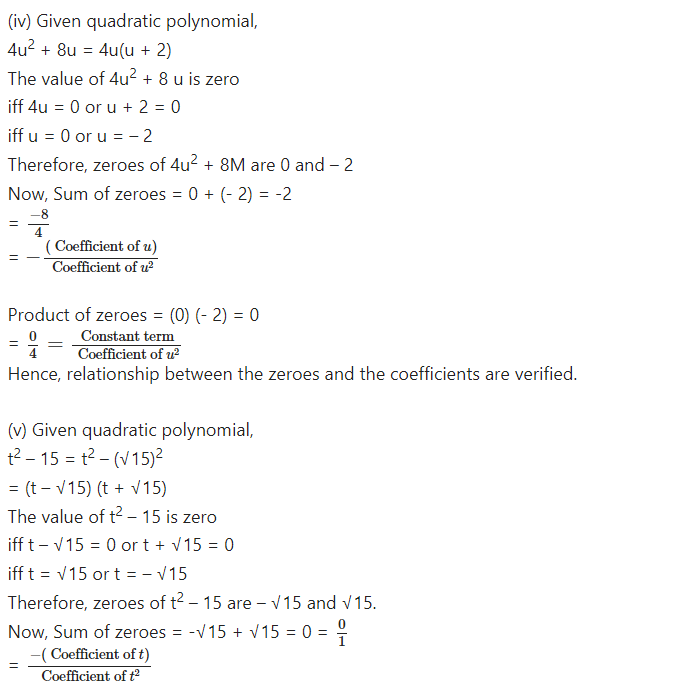
(iv) 4u2 + 8u
(v) t2 – 15
(vi) 3x2 – x -4
Solution:
(i) Given Quadratic polynomial,
x2 – 2x – 8
∵ [S = -2, P = -8]
= x2 – 4x + 2x – 8
= x (x – 4) + 2 (x – 4)
= (x – 4) (x + 2)
The value of x2 – 2x – 8 is zero,
iff (x – 4) = 0 or (x + 2) = 0
iff x = 4 or x = – 2
Therefore, zeroes of x2 – 2x – 8 are – 2 and 4.
Now, Sum of zeroes = (- 2) + (4) = 2




(iii) Given that, sum of zeroes and products of zeroes of given quadratic polynomial are 0 and √5 respectively.
Let the quadratic polynomial be ax2 + bx + c and its zeroes be α and β
α + β = Sum of zeroes = 0
and αβ = Product of zeroes = √5
Now, ax2 + bx + c = k(x – α) (x – β)
where k is any constant
= k [x2 – (a + (α+ β)x + αβ)
= k[x2 – 0x + √5]
= k[x2 + √5]
for different values of k, we get different quadratic polynomial.
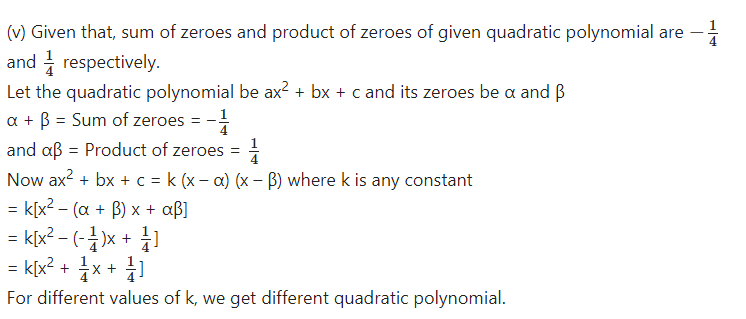
(iv) Given that, sum of zeroes and product of zeroes of given quadratic polynomial are 1 and 1 respectively.
Let the quadratic polynomial be ax2 + bx + c and its zeroes be α and β
α + β = Sum of zeroes = 1 and
αβ = Product of zeroes = 1
Now, ax2 + bx + c = k(x – α) (x – β)
where k is any constant.
= k [x2 – (α + β)x + αβ]
= k [x2 – 0x + √5]
= it [x2 – x + √5]
for different values of k, we get different quadratic polynomial.
(vi) Given that, sum of zeroes and product of zeroes of given quadratic polynomial are 4 and 1 respectively. Let the quadratic polynomial be
ax2 + bx + c and its zeroes be α and β
α + β = sum of zeroes = 4 and
αβ = Product of zeroes = 1
Now, ax2 + bx + c = k(x – α) (x – β) where k is any constant
= k [x2 – (α + β) x + αβ]
= k [x2 – 4x + 1]
For different values of k, we get different quadratic polynomials.