Table of Contents
About PSEB Solutions for Class 10 Maths Chapter 5 Arithmetic Progressions
In Class 10 Maths, Chapter 5 of the Punjab School Education Board (PSEB) syllabus covers Arithmetic Progressions (AP), which is an important topic in algebra. Exercise 5.3 focuses on solving problems related to arithmetic progressions. It involves finding the nth term of an AP, sum of the first n terms, and identifying the common difference. The solutions for this exercise require a clear understanding of the concepts of arithmetic progressions and the formulas associated with them. By practicing these problems, students can enhance their problem-solving skills and strengthen their knowledge of arithmetic progressions. It is important to thoroughly understand the concepts and then apply them to solve the given problems accurately.
PSEB 10th Class Maths Solutions Chapter 5 Arithmetic Progressions Ex 5.3
Question 1.mFind the sum of the following APs:
(i) 2, 7, 12, … to 10 terms.
(ii) – 37, – 33, – 29, ………….. to 12 terms.
(iii) 0.6, 1.7, 2.8, … to 100 terms.
(iv) 1/5, 1/12, 1/10, ………… to 11 terms.
Solution:
(i) Given AP. is 2, 7, 12, …
Here a = 2, d = 7 – 2 = 5 and n = 10
Sn = n/2 [2a + (n – 1) d]
∴ S10 = 10/2 [2 × 2 + (10 – 1)5]
= 5 [4 + 45] = 245.
(ii) Given A.P. is – 37, – 33, – 29…
Here a = -37, d = – 33 + 37 = 4 and n = 12
Sn = n/2 [2a + (n – 1) d]
∴ S12 = [2(-37) + (12 – 1)4]
= 6 [- 74 + 44] = – 180.


Question 3.
In an AP:
(i) given a = 5, d = 3, an = 50 find n and Sn.
(ii) given a = 7. a13 = 35, find d and S13.
(iii) given a12 = 37, d = 3. find a and S12.
(iv) given a3 = 15, S10 = 125, find d and a10.
(y) given d = 5, S9 = 75, find a and a9.
(vi) given a = 2, d = 8, Sn = 90, find n and an.
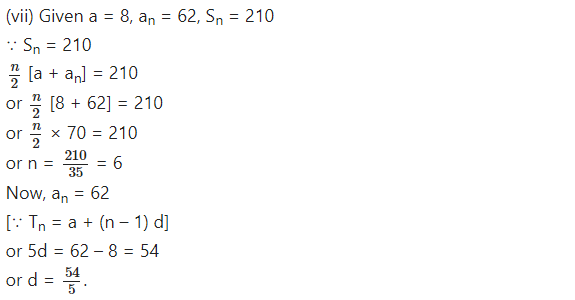
(vii) given a = 8, an = 62, Sn = 210, find n and d.
(viii)given an = 4, d = 2, Sn = -14, find n and a.
(ix) given a = 3, n = 8, S = 192, find d.
(x) given l = 28, S = 144, and there are total 9 terms. Find a.
Solution:
(i) Given a = 5, d = 3, an = 50
an = 50
a + (n – 1) d = 50
or 5 + (n – 1) 3 = 50
or 3 (n – 1) = 50 – 5 = 45
or n – 1 = 45/3 = 15
or n = 15 + 1 = 16
Now, Sn = latex]\frac{n}{2}[/latex] [a + l]
= latex]\frac{16}{2}[/latex] [5 + 50] = 8 × 55 = 440.

(iv)Given a3 = 15, S10 = 125
∵ a3 = 15
a + (n – 1) d = 15
a + (3 – 1) d = 15
or a + 2d = 15 …………….(1)
∵ S10 = 125
∵ [Sn = latex]\frac{n}{2}[/latex] [2a + (n – 1)d]
10/2 [2a + (10 – 1) d] = 125
or 5[2a + 9d] = 125
Note this
or 2a + 9d = 125/5 = 25
or 2a + 9d = 25 …………(2)
From (1), a = 15 – 24 …………..(3)
Substitute this value of (a) in (2i, we c1
2(15 – 2d) + 9d = 25
or 30 – 4d + 9d = 25
5d = 25 – 30
or d = −5/5 = -1
Substitute this value of d in (3), we get
a = 15 – 2(- 1)
a = 15 + 2 = 17
Now, a10 = 17 + (10 – 1)(- 1)
∵ Tn = a + (n – 1) d = 17 – 9 = 8.


(viii) Given an = 4, d = 2, Sn = – 14
∵ an = 4
a + (n – 1) d = 4
or a + (n – 1)2 = 4
or a + 2n – 2 = 4
or a = 6 – 2n ……………(1)
and Sn = – 14
n/2 [a + an] = – 14
or n/2 [6 – 2n +4] = – 14 (Using (1))
or n/2 [10 – 2n] = – 14
or 5n – n2 + 14 = 0
or n2 – 5n – 14 = 0
S = – 5
P = 1 × – 14 = – 14
or n2 – 7n + 2n – 14 = 0
or n(n – 7) + 2 (n – 7) = 0
or (n – 7) (n + 2) = 0
either n – 7 = 0
or n + 2 = 0
n = 7 or n = -2
∵ n cannot be negative so reject n = – 2
∴ n = 7
Substitute this value of n in (1), we get
a = 6 – 2 × 7
a = 6 – 14 = – 8.


Question 6. The first and last terms of an AP are 17 and 350 respectively. 1f the common difference is 9, how many terms are there and what is their sum?
Solution:
Given that a = T1 = 17;
l = an = 350 and d = 9
∵ l = an = 350
a + (n – 1) d = 350
17 + (n – 1) 9 = 350
or 9 (n – 1) = 350 – 17 = 333
or n – 1 = 333/9 = 37
n = 37 + 1 = 38
Now, S38 = n/2 [a + l]
= 38/2 (17 + 350]
= 19 × 367 = 6973.
Hence, sum of 38 terms of given A.P. arc 6973.
Question 7 Find the sum of first 22 terms of an AP. in which d = 7 and 22nd term is 149.
Solution:
Given that d = 7; T22 = 149 and n = 22
∵ T22 = 149
a + (n – 1) d = 149
or a + (22 – 1) 7 = 149
or a + 147 = 149
or a = 149 – 147 = 2
Now, S22 = [a + T22]
= 22/2 [2+ 149] = 11 × 151 = 1661
Hence, sum of first 22 temis of given A.P. is 1661.
Question 8. Find the sum of first 51 terms of an AP whose second and third terms are 14 and 18 respectively.
Solution:
Let ‘a’ and ‘d’ be fïrst term and common difference
Given that T2 = 14; T3 = 18 and n = 51
∵ T2 = 14
a + (n – 1) d = 14
a + (2 – 1)d = 14
or a + d = 14
a = 14 – d …………….(1)
and T3 = 18 (Given)
a + (n – 1) d = 18
a + (3 – 1) d = 18
or a + 2d = 18
or 14 – d + 2d = 18
or d = 18 – 14 = 4
or d = 4
Substitute this value of d in (1), we get

Question 9.If the sum of first 7 terms of an AP is 49 and that of 17 terms is 289, find the sum of first n terms.
Solution:
Let ‘a’ and ‘d’ be the first term and common difference of given A.P.
According to 1st condition

Question 10. Show that a1, a2, ……., an, … form an AP where is defined as below.
(i) an = 3 + 4n
(ii) an = 9 – 5n
Also find the sum of the first 15 terms In each case.
Solution:
(i) Given that an = 3 + 4n ………..( 1)
Putting the different values of n in(1), we get
a1 = 3 + 4(1) = 7;
a2 = 3 + 4 (2) = 11
a3 = 3 + 4 (3) = 15, …………
Now, a2 – a1 = 11 – 7
and a3 – a2 = 15 – 11 = 4
a2 – a1 = 11 – 7 = 4
and a3 – a2 = 4 = d(say)
∵ given sequence form an A.P.
Here a = 7, d = 4 and n = 15
∴ S15 = n/2 [2a + (n – 1)d]
= 15/2 [2(7) + (15 – 1) 4]
= 15/2 [14 + 56] = 15/2 × 70
= 15 × 35 = 525.
(ii) Given that an = 9 – 5n ……………….(1)
Putting the different values of n is (1), we get
a1 = 9 – 5(1) = 4;
a2 = 9 – 5(2) = -1;
a3 = 9 – 5(3) = -6.
Now, a2 – a1 = – 1 – 4 = – 5
and a3 – a2 = – 6 + 1 = – 5
∵ a – a1 = a3 – a2 = – 5 = d (say)
∴ given sequence form an A.P.
Here a = 4, d = – 5 and n = 15
∴ S15 = n/2 [2a + (n – 1) d]
= 15/2 [2(4) + (15 – 1) (-5)]
= 15/2 [8 – 70]
= 15/2 (-62) = – 465
Question 11. If the sum of the first n terms of an AP is 4n – n2, what is the first term (that is S1) ? What is the sum of two terms? What is the second term ? Similarly, find the 3rd, the 10th and the nth terms.
Solution:
Given that, sum of n terms of an A.P. are
Sn = 4n – n2
Putting n = 1 in (1), we get
S1 = 4(1) – (1)2 = 4 – 1
S1 = 3
∴ a = T1 = S1 = 3
Putting n = 2, in (1), we get
S2 = 4(2) – (2)2 = 8 – 4
S2 = 4
or T1 + T2 = 4
or 3 + T2 = 4
or T2 = 4 – 3 = 1
Putting n = 3 in (1), we get
S3 =4(3) – (3)2 = 12 – 9
S3 = 3
or S2 + T3 = 3
or 4+ T3 = 3
or T3 = 3 – 4 = – 1
Now, d = T2 – T1
d = 1 – 3 = -2
∴ T10 = a + (n – 1) d
= 3 + (10 – 1) (- 2)
T10 = 3 – 18 = – 15
and Tn = a + (n – 1) d
= 3 + (n – 1) (- 2)
= 3 – 2n + 2
Tn = 5 – 2n.