PSEB 10th Class Science Chapter 3 Metals and Non-metals
Table of Contents
IMPORTANT POINTS & KEY Notes about METAL AND NON METAL
→ Iron, Copper, Aluminium, Magnesium, Sodium, Lead, Zinc, etc. Metals are easily available.
→ Metals have shining surfaces, called metallic luster.
→ Sodium metal can be cut by a knife.
→ Metals are usually hard and can be beaten into thin sheets and drawn into wires.
→ Gold is most ductile that is why from one gram of gold, a 2km long wire can be drawn.
→ Metals are good conductors of heat.
→ Malleability and ductility are two important properties of metals.
→ Lead and mercury are bad conductors whereas silver and copper are very good conductors.
→ Metals have sonorous properties.
→ Carbon, Sulphur, Iodine, Oxygen, Hydrogen etc. are non-metals.
→ Bromine is a non-metal which exists in liquid form.
→ Mercury exists in liquid form at room temperature.
Gallium and Cesium have a very low melting point, which melts even when placed on our palms.
→ Iodine is non-metal but is lustrous.
→ Lithium, Sodium, Potassium are alkali metals and are very soft, they can be cut with a knife.
→ Most of the non-metals produce acidic oxides when dissolved in water.
→ Magnesium burns in the air with dazzling white flame.
→ On heating copper, it changes to black coloured copper oxide.
→ Those metal oxides that react with acid as well as with bases and produce salt and water in both cases are called amphoteric oxides.
→ Gold and silver do not react with oxygen even on heating.
→ Aqua regia is a fresh mixture of concentrated HCl and Concentrated HNO3 in the ratio 3 : 1.
→ Aqua regia can dissolve in Gold and platinum.
→ Reactivity series is a list of metals in which metals are arranged in decreasing activity.
→ Noble gases have completely filled valence shells and thus are less reactive.
→ Helium, Neon, Argon are Noble gases.
→ Compounds formed by the transfer of electrons from metals to non-metals are called ionic or electrovalent compounds.
→ Ionic compounds are solid and hard. They have high melting and boiling point. They can conduct electricity.
→ Earth’s crust is the main source of metals.
→ The elements or compounds which occur naturally in the earth’s crust are called minerals.
→ Some of the minerals from which extraction of metals is easy and profitable are called ores.
→ Gold, silver, platinum, and copper are at the bottom of the reactivity series and are least reactive, and are found in a free state.
→ Zinc, Iron, lead are moderately reactive and are found in the form of oxide, sulphide, or carbonate in the Earth’s crust.
→ Sodium, Potassium, calcium, Magnesium, Aluminium, etc. are at the top of the reactivity series and are so reactive that they are never found in a free state in nature.
→ Ores are contaminated with impurities like soil, sand, etc. known as gangue.
→ If sulphide ores are heated in excess air, they convert to oxides. This is called roasting.
→ Carbonate ores are converted into oxides by heating them strongly in a limited supply of air. This is known as calcination.
→ The reaction of iron oxide with aluminium is called the thermit reaction.
→ Electrolytic refining is used to purify metals.
→ Silver articles become black after some time when exposed to air due to the formation of a coating of silver sulphide.
→ Copper gains a green coating of basic copper carbonate due to corrosion when left in air for a long time CuCO3.Cu(OH)2.
→ Iron acquires a brown coating called rust.
→ Corrosion is prevented by greasing, painting, galvanising, chrome plating, anodizing, etc.
→ The homogeneous mixture of two or more two metals is called an alloy.
→ Pure Gold, which is 24-carat gold, which is very soft.
→ For making ornaments silver or copper is mixed with gold.
→ Generally, 22-carat gold is used for making ornaments. If alloy contains one of its constituents as mercury (Hg) it is called amalgam.
→ Alloy Bronze is a bad conductor of electricity.
→ Ductility: It is a property of metals by virtue of which long wires can be drawn. Electric wire is an example of ductility.
→ Malleability: It is a property of metals by virtue of which metals can be beaten into thin sheets.
→ Conductivity: Metals allow the passage of heat and electricity through them, this is called conductivity.
→ Mineral: Substances from which metals can be extracted are called minerals. Metals can be extracted from minerals by different methods.
→ Metallurgy: To extract metals from their ores and purify them for use is called metallurgy.
→ Ore: Those minerals from which metal extraction is easy and profitable are called ores.
→ Gangue: Ores mined from the earth are contaminated with impurities such as soil, sand, etc. are called gangue.
→ Roasting: The process of converting enriched ore in the excess of air is called roasting.
→ Reduction: It is a process of obtaining metals from compounds.
→ Purification: It is a process of obtaining pure metal from impure metal.
→ Alloy: Mixture of a metal with other metal or non-metal in the called alloy.
→ Allotropy: A property by virtue of which non-metals exist in different forms is called allotropy.
→ Vulcanization: Mixing sulphur with natural rubber is called vulcanization and such rubber is called vulcanized rubber.
→ Slag: It is a substance that is obtained when gangue and smelter are together.
→ Smelter: It is a substance which is used to separate gangue in the form of liquid from an impure metal.
→ Calcination: It is a process of heating ore in the limited supply of air. Ore becomes porous in this process.
→ Smelting: It is a process to extract an element from its ore using heat and a reduction agent.
→ Metals: Metals are those elements which lose electrons to form positive ions.
→ Non-Metals: Non-Metals are those elements which gain electrons to form negative ions.
→ Amalgam: When one of the constituents of an alloy is mercury it is called an alloy.
→ Corrosion: The effect of air, water, or any other substance on the surface of the metal is called corrosion.
→ Strategic metals: These are the metals that are important for the economy and safety of the country are strategic metals.
→ Electropositive elements: Those elements which lose electrons to form positive ions are known as electropositive elements: Metals belong to this category.
→ Electronegative elements: Those elements which gain electrons to form negative ions are known as electronegative elements. Non-metals belong to this category.
→ Reactivity series of metals: Arrangement of metals in a column in decreasing reactivity of metals is called reactivity series of metals.
→ Displacement reactions: The replacement of less reactive metal by more reactive metal from its salt in a reaction is called displacement reaction.
→ Catalyst: These are substances that do not take part in a reaction but can increase or decrease the rate of reaction are called catalysts.
→ Promotor: Substances that increase the performance of catalysts are called promotors.
Metals and Non-metals InText Questions and Answers
Question 1. Give an example of a metal which :
(i) is a liquid at room temperature
Answer: Mercury
(ii) can be easily cut with a knife
Answer: Sodium
(iii) it is the best conductor of heat
Answer:
Silver
(iv) is a poor conductor of heat.
Answer:
Lead.
Question 2. Explain the meaning of malleable and ductile.
Answer:
Malleable: A substance is said to be malleable, if it can be beaten into sheets. e.g. metals are malleable.
Ductile: A substance is said to be ductile, if it can be drawn into wires e.g. the metals are ductile.
Question 3. Why is sodium kept immersed in kerosene oil?
Answer:
This is because in contact with moist air containing carbon dioxide, it is covered with a carbonate layer.
4Na + O2 → 2Na2O
Na2O + H2O → 2NaOH
2NaOH + CO2 → Na2CO3 + H2O
Also sodium reacts with water.
2Na + 2H2O → 2NaOH + H2
Hence, sodium is kept immersed in kerosene oil.
Question 4. Write equation for the reactions of
(i) iron with steam
Answer:
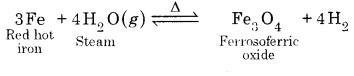
(ii) calcium and potassium with water.
Answer:
Ca + 2H2O → Ca(OH)2 + H2
2K + 2H2O → 2KOH + H2
Question 5. Samples of four metals A, B, C and D were taken and added to the following solution one by one. The results obtained have been tabulated as follows :
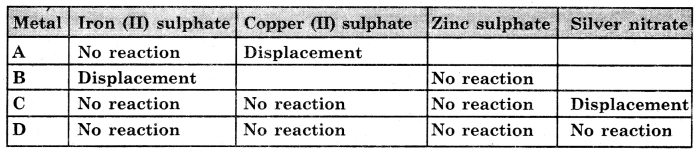
Use the table above to answer the following questions about metals, A, B, C and D.
(i) Which is the most reactive metal?
Answer:
B is the most reactive metal.
(ii) What would you observe if B is added to a solution of copper (II) sulphate?
Answer:
B will displace copper from copper sulphate solution.
(iii) Arrange the metals A, B, C and D in the order of decreasing reactivity.
Answer:
The decreasing order of reactivity is B > A > C > D.
Question 6. Which gas is produced when dilute hydrochloric acid is added to a reactive metal? Write the chemical reaction when iron reacts with dilute H2SO4.
Answer:
Hydrogen gas is produced when dilute hydrochloric acid is added to a reactive metal.

Question 7. What would you observe when zinc is added to a solution of iron (II) sulphate? Write the chemical reaction that takes place.
Answer:
When zinc is added to a solution of iron (II) sulphate it will displace iron from it and light green colour of solution gradually fades away.

Question 8. (i) Write the electron-dot structures for sodium, oxygen and magnesium.
Answer:
Electron-dot structures for sodium, oxygen and magnesium are

(ii) Show the formation of Na2O and MgO by the transfer of electrons.
Answer:
Formation of Na2O:

iii) What are the ions present in the above compounds?
Answer:

Question 9. Why do ionic compounds have high melting points?
Answer:
In ionic compounds there are strong electrostatic forces of attraction between oppositely charged ion and a considerable amount of energy is required to break the strong interionic attraction.
Question 10. Define the terms :
(a) mineral
Answer:
Mineral. The compounds of elements occurring in earth’s crust which are associated with earthly impurities are called minerals.
(b) ore
Answer:
Ore. An ore is a mineral from which metal can be extracted conveniently and economically.
(c) gangue.
Answer
Gangue. The earthly impurities such as sand, lime stone, rocks etc. associated with minerals and ores are collectively known as gangue or matrix.
Question 11. Name two metals which are found in nature in the free state.
Answer:
Gold and Platinum.
Question 12. What chemical process is used for obtaining a metal from its oxide?
Answer:
Reduction process.
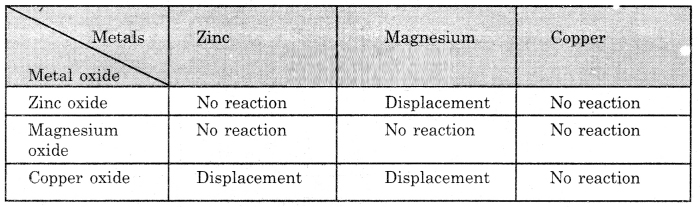
Question 13. Metallic oxides of zinc, magnesium and copper were heated with the following metals :
| Metal | Zinc | Magnesium | Copper |
| Zinc oxide | |||
| Magnesium oxide | |||
| Copper oxide |
In which cases will you find displacement reactions taking place?
Answer:
Zinc can displace copper from copper oxide
In which cases will you find displacement reactions taking place?
Answer:
Zinc can displace copper from copper oxide
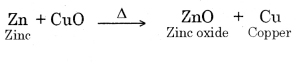
Magnesium can displace zinc from zinc oxide

Also Mg can displace copper from CuO
Question 14. Which metals do not corrode easily?
Answer:
The metals which are not attacked by air and moisture don’t corrode easily.
Question 15. What are alloys?
Answer:
Alloys. These are the homogeneous mixtures of two or more metals or metals and non-metals.
Acids, Bases and Salts Textbook Questions and Answers
Question 1. Which of the following pairs will give displacement reactions :
(а) NaCl solution and copper metal
(b) MgCl2 solution and aluminium metal
(c) FeSO4 solution and silver metal
(d) AgNO3 solution and copper metal?
Answer:
(d) AgNO3 solution and copper metal?
Question 2. Which of the following methods is suitable for preventing an iron frying pan from rusting :
(a) applying grease
(b) applying paint
(c) applying a coating of zinc
(d) all of the above :
Answer:
(c) applying a coating of zinc
Question 3. An element reacts with oxygen to give a compound with a high melting point. This compound is also soluble in water. The element is likely to be :
(a) calcium
(b) carbon
(c) silicon
(d) iron.
Answer:
(a) calcium
Question 4. Food cans are coated with tin and not with zinc because :
(а) zinc is costlier than tin
(b) zinc has a higher melting point than tin
(c) zinc is more reactive than tin
(d) zinc is less reactive than tin.
Answer:
(c) zinc is more reactive than tin
Question 5. You are given a hammer, a battery, a bulb, wires and a switch.
(i) How could you use them to distinguish between samples of metals and non-metals?
(ii) Assess the usefulness of these tests in distinguishing between metals and non-metals.
Answer:
(i) Set up the electric circuit as shown below :
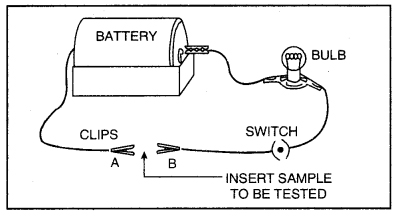
To distinguish between metals and non-metals on the basis of their electrical conductivity.
Insert the sample to be tested between clips A and B
If the bulbs glows, the sample is metal.
If the bulb does not glow, the sample is non-metal.
Thus metals are good conductors of electricity whereas non-metals are poor conductors of electricity.
(ii) If a substance produces a sound when struck beating with a hammer, it is a metal and if no sound is produced, it is a non-metal.
Metals are sonorous whereas non-metals are non-sonorous.
Question 6. What are amphoteric oxides? Give two examples of amphoteric oxides.
Answer:
Amphoteric oxides. The metal oxide which react both with acids as well as bases to produce salts and water are known as amphoteric oxides.
Examples. Zinc oxide, ZnO Aluminium oxide, Al2O3
Question 7. Name two metals which will displace hydrogen from dilute acids, and two metals which will not.
Answer:
Zinc and magnesium can displace hydrogen from dilute acids. Copper and silver cannot displace hydrogen from dilute acids.
Question 8. In the electrolytic refining a metal M, what would you take as the anode, the cathode and the electrolyte?
Answer:
During the electrorefining of metal, the impure metal is made as anode, a thin strip of pure metal M is made as cathode. The electrolyte used a soluble salt of metal M. to be refined.
Question 9. Pratyush took sulphur powder on a spatula and heated it. He collected the gas evolved by inverting a test tube over it as shown in figure
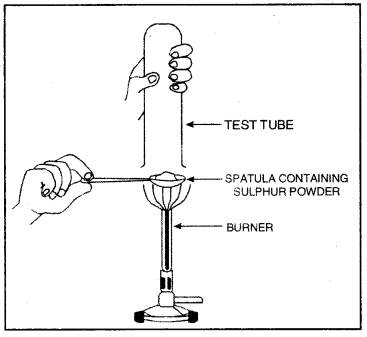
Collection of Gas
(a) What will be the action of gas on
(i) dry litmus paper?
Answer:
No action.
(ii) moist litmus paper?
Answer:
It turns moist litmus paper red and then bleaches it.
(b) Write a balanced chemical equation for the reaction taking place.
Answer:
S + O2 → SO2
Question 10. State two ways to prevent the rusting of iron.
Answer:
The rusting can be prevented by
- By painting, oiling, greasing, galvanising, chrome plate or anodising.
- By forming alloys.
Question 11. What type of oxides are
Answer:
As they form two types of oxides :
(a) Neutral oxides such as CO, NO etc.
(b) Acidic oxides such as SO2, CO2 etc.
Question 12. Give reasons :
(a) Platinum, gold and silver are used to make jewellery.
Answer:
Platinum, gold and silver are used to make jewellery because these are not attacked by air and moisture. They don’t undergo corrosion and retain their lustre for a long time. Also these metals are malleable and ductile.
(b) Sodium, potassium and lithium are stored under oil.
Answer:
Sodium, potassium and lithium are stored under oil because in contact with moist air containing carbon dioxide, these are covered with a carbonate layer.
e.g. 4Na + O2 → 2Na2O
Na2O + H2O → 2NaOH
2NaOH + CO2 → Na2CO3 + H2O
Also they react with water.
e.g. 2Na + 2H2O → 2NaOH + H2.
Hence, these metals are stored under oil.
(c) Aluminium is a highly reactive metal, yet it is used to make utensils for cooking.
Answer:
This is due to the reason that a thin sticking oxide layer of aluminium is formed on its surface which prevents further reaction. Also aluminium is a good conductor of heat and the oxide layer (Al2O3) is stable even at high temperatures.
(d) Carbonate and sulphide ores are usually converted into oxides during the process of extraction.
Answer:
This is because it is easier to obtain a metal from its oxide as compared to its sulphide and carbonate ore.
Question 13. You must have seen tarnished copper vessels being cleaned with lemon or tamarind juice. Explain why these sour substances are effective in cleaning the vessels.
Answer:
In tarnished copper vessel there is a layer of basic copper carbonate. This basic layer can be cleaned by using sour substances such as lemon or tamarind juice which are acidic in nature and dissolve the basic coat of copper carbonate
Question 14. Differentiate betw een metals and non-metals.
Or
Differentiate between metals and non-metals on the basis of their chemical properties.
Answer:
Differences between metals and non-metals :
| Metals | Non-Metals |
| 1. They form basic oxides. | 1. They form acidic or neutral oxides. |
| 2. They displace hydrogen from dilute acids. | 2. They don’t displace hydrogen from dilute acids. |
| 3. Usually they don’t combine with hydrogen. Only a few reactive metals combine with hydrogen to form metal hydroxide which are electrovalent compounds. | 3. They react with hydrogen to form hydrides which are covalent compounds. |
| 4. They form chlorides which are electrovalent compounds. | 4. They react with chlorine to form chlorides which are covalent compounds. |
Question 15. A man went door to door posing as a goldsmith. He promised to bring back the glitter of old and dull gold ornaments. An unsuspecting lady gave a set of gold bangles to him which he dipped in a particular solution. The bangles sparkled like new but their weight was reduced drastically. The lady was upset but after a futile argument the man beat a hasty retreat. Can you play the detective to find out the nature of the solution he had used?
Answer:
The solution used by goldsmith to bring back the glitter of old and dull gold ornaments was aqua regia. It is a freshly prepared mixture of cone. HCl and cone. HNOg in the ratio 3 : 1. It can dissolve gold,
Question 16. Give the reasons why copper is used to make hot water tanks but steel (an alloy of iron) is not.
Answer:
This is because iron present in steel reacts with steam to form ferrosoferric oxide whereas copper has no action with water. As a result of it, the body of the steel tank becomes weaker and weaker in case of iron and not in case of copper.

Questions Chapter 3 Metals and Non-metals Multiple Choice Questions :
Question 1. The non-metal which is liquid at room temperature is:
(A) Chlorine
(B) Bromine
(C) Fluorine
(D) Iodine.
Answer:
(B) Bromine
Question 2. Most reactive metal is:
(A) Na
(B) Mg
(C) Au
(D) K
Answer:
(D) K
Question 3. The property due to which metals can be beaten into sheets is :
(A) Malleability
(B) Ductility
(C) Metallic lustre
(D) Hardness.
Answer:
(A) Malleability
Question 4. The axnphoteric oxide is:
(A) ZnO
(B) BaO
(C) K2O
(D) Na2O.
Answer:
(A) ZnO
Question 5. Copper gets covered with green layer when exposed to air due to the formation of:
(A) CuSO4
(B) CuCO3. Cu(OH)2
(C) Cu (NO3)2
(D) CuO.
Answer:
(B) CuCO3. Cu(OH)2
Question 6. During galvanisation, the metal whose layer is deposited is:
(A) Gallium
(B) Aluminium
(C) Zinc
(D) Silver.
Answer:
(C) Zinc
Question 7. The non-metal which is a good conductor of electricity:
(A) Sulphur
(B) Phosphorus
(C) Graplite
(D) Iodine.
Answer:
(C) Graplite
Question 8. Which non-metal is liquid at room temperature:
(A) Carbon
(B) Sulphur
(C) Bromine
(D) Oxygen.
Answer:
(C) Bromine
Question 9. Which is the most malleable metal?
(A) Gold
(B) Lead
(C) Iron
(D) Copper
Answer:
(A) Gold
Question 10. Metals of low reactivity are extracted by:
(A) By heating alone
(B) By electrolysis
(C) By reduction
(D) None
Answer:
(A) By heating alone
Very Short Answer Type Questions
Question 1. Give one example of metal which is liquid at room temperature.
Answer:
Mercury.
Question 2. Name one metal and one non-metal which is liquid at room temperature.
Answer:
Metal-Mercury.
Non-Metal—Bromine
Question 3. Name one non-metal which has bright lustre.
Answer:
Iodine.
Question 4. Name one non-metal which does not have bright.
Answer:
Phosphorus.
Question 5. Which of the following metal are liquid at body temperature (37° C): Gallium, Magnesium, Caesium, Aluminium.
Answer:
Gallium and Caesium.
Question 6. Name one non-metal which is a good conductor of electricity?
Answer:
Graphite (Carbon).
Question 7. Arrange the following metals in the decreasing order of reactivity,
Fe, Zn, Cu, Na, Ag.
Answer:
Na > Zn > Fe > Cu > Ag.
Question 8. Out of Sodium, Calcium, Aluminium, Copper and Magnesium name the metal which reacts with
(i) Boiling water
Answer:
Magnesium
(ii) Steam.
Answer:
Copper.
Question 9. Sodium metal is kept under kerosene oil, why?
Answer:
This is because sodium reacts with moist air as well as water.
Question 10. A non-metal X, exists in two forms Y and Z. Y is the hardest substance and Z is a poor conductor of electricity. What are X, Y and Z?
Answer:
Y = Diamond Z = Graphite X = Carbon
Y and Z are allotropic forms of carbon.
Question 11. An element, A form two oxides AO and AOa. AO is neutral and AO2 is acidic : Indicate whether A is metal or non-metal.
Answer:
A is non-metal.
Question 12. Name the reaction to convert metal into its oxide .
Answer:
Oxidation.
Question 13. Ionic solids have high melting points, why?
Answer:
In ionic solids, there are strong electrostatic forces of attraction between the oppositely charged ions and a large amount of energy required to overcome these forces.
Question 14. An element X reacts with oxide to form oxide, X2O which dissolves in water and turns red litmus solution blue. Give the nature of oxide and indicate X is metal or non-metal.
Answer:
X2O is basic. X is metal.
Question 15. What is the nature of metal oxides?
Answer:
Basic.
Question 16. Name two noble metals.
Answer:
Gold and platinum.
Question 17. Name an ore of mercury.
Answer:
Mercury sulphide (Hgs).
Question 18. Name two metalloids.
Answer:
Arsenic, antimony.
Question 19. Metals lose lustre when placed in air, why?
Answer:
This is because their surfaces are covered with oxides, carbonates or sulphide layer’s .
Question 20. Name two metals which can be cut with a knife.
Answer:
Sodium and potassium.
Question 21. Why do metals aquire different shapes?
Answer:
This is due to malleability and ductility of metals.
Question 22. Name the metal which is poor conductor of heat.
Answer:
Lead.
Question 23. Name the metal which offers resistance to the flow of electricity.
Answer:
Mercury.
Question 24. Which of the following metals can be drawn into wires?
Answer:
Cu, Al, Fe, Pb.
Question 25. Name four non-metals which are solid at room temperature.
Answer:
Carbon, Sulphur, Phosphorous, and iodine.
Question 26. Name the elements which are present in abundance in earth’s crust.
Answer:
Oxygen and silicon.
Question 27. What are alkalies? Give one example.
Answer:
Alkali. It is a metal hydroxide soluble in water Example : Sodium hydroxide (NaOH).
Question 28. Name two amphoteric oxide.
Answer:
- Aluminium oxide (Al2O3)
- Zinc Oxide (ZnO)
Question 29. What happens when magnesium is heated to ignition temperature?
Answer:
Magnesium burns with white light producing magnesium oxide.
Question 30. Name the metal which does not react with dil. HCl.
Answer:
Copper.
Question 31. Name two metals which react with hydrogen.
Answer:
Sodium and potasium.
Question 32. Give the reaction when a piece of Calcium reacts with water.
Answer:
Ca + 2H2O → Ca (OH)2 + 4H2.
Question 33. Give the reactions when red hot iron reacts with steam.
Answer:
Ca + 4H2O → Fe3O4 + H2.
Question 34. Why is zinc oxide called amphoteric oxide?
Answer:
This is because zinc oxide reacts with both acid as well as base.
Question 35. The metals Na, K and Ca react with hydrogen to form hydroxide but other metals don’t, why?
Answer:
This is because Na, K and Ca are highly reactive metals.
Question 36. Give the reactions which occur when zinc plate is added to copper sulphate solution.
Answer:
Zn + CuSO4 → ZnSO4 + Cu.
Question 37. Out of the metals, Na, Cu, Au, which is
(i) Most reactive and
Answer:
Most reactive metal-Sodium (Na)
(ii) Least reactive?
Answer:
Least reactive metal-Gold (Au).
Question 38. Arrange the following metals in the decreasing order of reactivity, Zinc, Mercury and Aluminium.
Answer:
Al < Zn < Hg.
Question 39. Name two metals which occur in free state in nature.
Answer:
Gold and Platinum.
Question 40. Define corrosion of metals.
Answer:
It is the interaction of surface of metal with air and moisture forming a layer of oxide, halide or carbonate layer on its surface.
Question 41. Name a metal which undergoes corrosion in air.
Answer:
Iron.
Question 42. Name two metals which are not corroded easily.
Answer:
Gold and silver.
Question 43. Why does copper utensils turn green on exposure to air?
Answer:
Copper reacts with oxygen, carbon dioxide and moisture to form a green coloured compound (basic copper carlxmate):

Question 44. Name two metals which are both malleable and ductile.
Answer:
- Copper
- Aluminium.
Question 45. Name the most abundant metal in the earth’s crust.
Answer:
Aluminium.
Question 46. Name the metal that gives a green coating when exposed to moisture.
Answer:
Copper.
Question 47. Which is the most lightest metal known to us?
Answer:
Lithium.
Question 48. Name two metals which occur in free state in nature.
Answer:
- Gold
- Platinum.
Question 49. Name one of the most common ore of aluminium.
Answer:
Bauxite (Al2O3. 2H2O).
Question 50. What is an amalgam?
Answer:
An amalgam is an alloy of mercury with some other metals.
Question 51. Name two metals which :
(a) readily burn in air an
Answer:
Metals which readily burn in air are :
- sodium
- magnesium.
(b) do not burn.
Answer:
metals which do not burn readily in air are :
- Copper
- iron.
Question 52. Name the metal which is best conductor of electricity.
Answer:
Silver.
Question 53. Name one metal which reacts with cold water.
Answer:
Sodium.
Question 54. Name one metal
(i) more reactive than hydrogen and
Answer:
Sodium
(ii) less reactive than hydrogen.
Answer:
Silver.
Question 55. Write the chemical name of any one compound ore of sulphur.
Answer:
Zinc sulphide (ZnS).
Question 56. Name the metal used in galvanisation of iron.
Answer:
Zinc.
Question 57. The metal which is found in nature in the free state is
Answer:
Gold and Platinum.
Question 58. What chemical process is used for obtaining a metal from its oxide?
Answer:
Reduction process.
Question 59. Which metals do not corrode easily?
Answer:
The metals which are not attacked by air and moisture don’t corrode easily.
Question 60. Name the strongest chemical bond.
Answer:
Electrovalent or ionic bond.
Short Answer Type Questions
Question 1. Name two metals which are good conductors of heat and electricity. Name metals which are highly and least conducting with reference to heat.
Answer:
Copper and aluminium are good conductors of electricity and heat. Silver is very good conductor of heat whereas lead is not a good conductor of heat.
Question 2. Define ductility with example.
Answer:
Property of drawing thin wires from a metal is called ductility. Gold is the highest ductile metal. We can draw 2 km long wire from 18 carat gold.
Question 3. What is electrical conductivity? Name the metals which have the highest conductivity, less than this and the lowest conductivity.
Answer:
It is the ease with which electric current can flow through a metal. Those metals which offer very low resistance to the flow of current they have high conductivity. Silver, copper are very good conductors of current then comes gold, aluminium and tungsten. Lead and iron have least conductivity i.e., they offer very high resistance to the flow of current.
Question 4. Which property of metals give them characteristic chemical properties?
Answer:
Metals form positive ions by loosing electrons. This property of formation of ions by the metals give them characteristics chemical properties, e.g., Mg form Mg ion by loosing two electrons :
Mg → Mg2+ + 2e–
Question 5. Ionic compounds are found in which state? Comment on the melting and boiling point of ionic compounds.
Answer:
Compounds which are formed by the transfer of electrons from metals to Non¬Metals are called ionic or electrovalent compounds e.g., NaCl, LiCl, CaCl2, CaO, MgCl2. Ionic compounds have very high melting and boiling points because a large amount of energy is required to break the strong inter-ionic attractions.
Question 6. What is difference between minerals and ores?
Answer:
| Sr. No. Minerals | Ores |
| 1. Those natural occuring substances, which contain metals in the form of compounds. | 1. These are the minerals from which metals can be extracted easily and cheaply. |
| 2. In many of the minerals percent age amount of metals is large and in some it is less. | 2. In all the ores, percentage amount of metals is enough. |
| 3. In some minerals there are so many impurities which create difficulty in the extraction of metals. | 3. Ores do not have such problematic impurities. |
| 4. All the minerals can not be used for extracting metals. All the minerals are not ores. | 4. All the ores can be used to extract metals. |
Question 7. How are the metals extracted, which are at the top of reactivity series?
Answer:
Metals which are towards the top of reactivity series are sodium, calcium, magnesium, aluminium. There are very reactive. These metals can not be obtained by heating them with carbon. These have more affinity towards oxygen, therefore these are extracted by electrolytic reduction. Sodium, magnesium and calcium are obtained by the electrolysis of their molten chlorides. Metals got deposited at cathode and chorine is liberated at anode.
At cathode : Na+ + e– → Na
At anode : 2Cl– → Cl2 + 2e–
Aluminium is obtained by the electrolytic reduction of aluminium oxide.
At cathode ; Al3+ + 3e– → Al

Question 8. How the metals, which are in the middle of the activity series extracted?
Answer:
Metals which are in the middle of the activity series are iron, zinc, lead, copper etc. These are found in the form of sulphides or carbonates. It is easy to obtain metals from their oxides compared to sulphides or carbonates. Therefore before extraction metal sulphide or carbonates are converted into their oxide. Sulphide ores are converted into metal oxides by heating in the presence of air. This is known as roasting. Carbonate ores are heated in limited supply of air to convert them into oxides. This is known as calcination. Following reactions take place during roasting and calcination of zinc.


Then by using carbon as reducing agent, metal is extracted from metal oxide, e.g. when Zinc oxide is heated with carbon it gets reduced to give zinc.

In addition to using carbon for reduction, displacement reaction can be used to extract metals. More reactive metals like sodium, calcium, aluminium etc. can be used as reducing agents because these can displace atoms which are below them in the reactivity series. For example, when mangnese dioxide is heated with aluminium powder then following reaction takes place.

Question 9. How will you extract metals which are low in the activity series?
Answer:Metals low in the activity series are less reactive and can be obtained from metal oxides simply by heating. Cinnabar (Hgs) an ore of mercury (Hg) when heated change to mercuric oxide (HgO), on heating it further it is reduced to mercury.
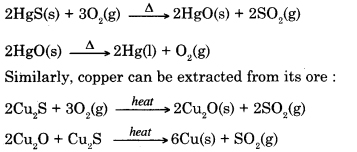
Question 10. Explain the reactions of metals with water.
Answer:
On reacting with water, metals form metal oxide and produce hydrogen. These dissolve in water to form metal hydroxide. But all metals do not react with water.
Metals like sodium and Potassium react with cold water, vigorously. The reaction of sodium and Potassium is very vigorous and exothermic that hydrogen produced starts burning simultaneously.
2K (s) + 2H2O (l) → 2KOH (aq) + H2(g) + heat
2Na (s) + 2H2O (l) → 2NaOH (aq) + H2(g) + heat
Reaction of calcium with water is slow. Heat produced in this reaction is not enough to burn the hydrogen produced in the reaction.
Ca (s) + 2H2O(l) → Ca (OH)2 + H2(g)
Metals like iron, aluminium, zinc etc. do not react with cold water and not even with hot water. But they react with steam to form metal oxide and produce, hydrogen.
2Al(s) + 3H2O(g) → Al2O3(S) + 3H2(g)
3Fe(s) + 4H2O(g) → Fe3O4(s) + 4H2(g)
Metals like lead, copper, silver and gold etc. do not react with water.
Question 11. How do metals react with :
1. Oxygen
2. Dilute acids
3. Chlorine
4. Hydrogen.
Answer:
I. Reaction of metals with oxygen: Metals combine with oxygen to form metal oxides. Metal atoms lose their loosely bound electrons to form positive ions where as oxygen atoms gain electrons to form negative oxide ions. These metal oxide are basic in nature. Since all metals have different level of reactivity therefore they combine with oxygen at different temperatures.
1. Na and K Combine with oxygen at normal temperature to form oxides which dissolve in water to form hydroxide.
4 Na (s) + O2(g) → 2Na2S(s)
Na2O(s) + H2O → 2NaOH (or)
2. If magnesium is burned in air it forms magnesium oxide.
Mg → Mg2+ + 2e-
O + 2e– → O2-
Mg2+ + O2- → MgO
3. Copper and iron combine with oxygen at high temperature in dry air.
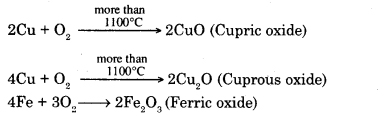
. Reaction of metals with dilute acids. Metals reacts with dilute acids to produce hydrogen gas. Rate of reactivity is different.
1. Na, K, Zn, Mg, Fe etc. are reactive in decreasing order.
2Na + HCl → 2NaCl + H2 ↑
Mg + 2HCl → MgCl2 + H2↑
Zn + H2SO4 → ZnSO4 + H2↑
2. Dilute nitric acid reacts with metals like Cu, Ag, Pb, Hg to form NO (nitrogen oxide).
Cu + 8HNO3 → 3Cu (NO3)2 + 2NO + 4H2O
3Ag + 4HNO3 → 3AgNO3 + NO + 2H2O
3. Dilute nitric acid reacts with Mg and Mn to produce hydrogen gas.
Mg + 2HNO3 → Mg (NO3)2 + H2 ↑
4. Gold and platinum do not react with dilute acids.
III. Reaction of metals with chlorine. Metals combines with chlorine to form electrovalent chlorides.
Ca + Cl2 → CaCl2
IV. Reaction of metals with hydrogen. Reactive metals like Na, K, Ca etc. react with hydrogen to form hydrid.
2Na + H2 → 2NaH
Ca + H2 → CaH2
V. Reaction of metals with water:
1. Water at normal temperature react with Na, K and Ca to liberate hydrogen gas.
2Na + 2H2O → 2NaOH + H2 ↑
Ca + 2H2O → Ca (OH)2 + H2 ↑
2. Mg, Zn and Fe react with boiling water to form oxide.
Mg + H2O → MgO + H2 ↑
3Fe + 4H2O → Fe3O4 + 4H2 ↑
Question 12. What is roasting? When do you use it?
Answer:
Roasting. After enrichment of ore, it is heated in the presence of dir, this process is called roasting sulphides or carbonates of some metals are converted into oxides, because extraction of metal is easy from oxides. Carbonates and sulphides of zinc and lead are converted into oxides by roasting.

Question 13. If a copper plate remains immersed in silver nitrate solution for some time then what happens? Write the ionic equation for the reaction.
Answer:
Copper is more reactive than silver. Copper will displace silver from the solution and silver gets deposited on copper. Colour of the solution becomes blue.

Question 14. What is 24 carat gold?
Answer:
Pure gold is called 24 carat gold. It is very soft. It can be used to make ornaments. Small amount of silver or copper is mixed with it to make it harder. In our country usually 22 carat gold is used to make ornaments. This means 22 pure gold is mixed with 2 parts of copper or silver.
Question 15. Give five uses of non-metals.
Answer:
- Hydrogen is used in the preparation of vegetable oil.
- Carbon is an important non-metal which is main constituent of vitamins, proteins, carbohydrates, enzymes etc. Graphite is used as an electrode in various cells.
- Nitrogen is used in ammonia, Nitric acid and fertilizers. Its presence in air controls the rate of combustion.
- Presence of oxygen is the base of our life. Combustion is also possible in the presence of oxygen.
- Sulphur is used in many medicines and is also used to make explosives.
Question 16. What is aqua regia? Explain.
Answer:
Aqua regia is a mixutre of concentrated hydrochloric acid and concentrated nitric acid in the ratio of 3 : 1. It can dissolve gold where no single acid can do this. Aqua regia (Latin word for Royal water) is highly corrosive and fuming liquid. It can also dissolve platinum.
Question 17. What is rust? What is its chemical formula?
Answer:
When iron is left open in air, then a layer of iron oxide is formed on the surface of iron. This brown matter is rust. It corrodes the metal. Its chemical formula is Fe2O3. xH2O.
Long Answer Typt Questions
Question 18. How will you differentiate between metals and non-metals?
Answer:
Differences between metals and non-metals on the basis of physical properties :
| Metals | Non-metals |
| 1. All metals are solid at room temperature. But mercury is liquid at room temperature. | 1. Non-metals exist in all the three states at room temperature. Phosphorous and sulphur are solid, H2, O2, N2 in gaseous state, and bromine in liquid state. |
| 2. Metals are ductile, malleable and tenacious. | 2. These are soft. |
| 3. Metals have lustre i.e. metal shine. | 3. They do not have lustre but diamond, graphite and iodine are exceptions. |
| 4. Metals are good conductors of heat and electricity but bismuth is exception. | 4.All non metals are non conductors except graphite and carbon gas. |
| 5. Metals have high melting and boiling points. | 5. Non metals have low melting and boiling points. |
| 6. Metals are hard but sodium and potassium can be cut by knife. | 6. These are not very hard but diamond is the hardest substance. |
| 7. Metals have very high relative densities but Na, K are exceptions. | 7. Non metals have very low relative densities. |
| 8. Metals are opaque. | 8. Gaseous non metals are transparent. |
Difference between metals and non-metals on the basis of chemical properties
| Metals | Non-metals |
| 1. Metals form alkaline oxides some of them form bases. | 1. Non-metals form acidic or neutral oxides. |
| 2. Metals react with acids to displace hydrogen and form salts. | 2. Non-metals do not displaces hydrogen from acids. |
| 3. Metals are electropositive in nature. | 3. Non-metals are electronegative in nature. |
| 4. Metals combine with chlorine to form chlorides which are electrovalent compounds. | 4. Non-metals combine with chlorine to form chlorides which are covalent compounds. |
| 5. Some metals combine with hydrogen to form hydrides which are electrovalent. | 5. Non-metals combine with hydrogen to form hydrides which are covalent. |
| 6. Metals are reducing agents. | 6. Non-metals are oxidizing agents. |
| 7. Metals form positive ions in aqueous solution. | 7. Non-metals form negative ions in aqueous solution |
Question 2. Explain General properties of ionic compounds.
Answer:
General properties of ionic compounds are given below:
- Physical nature: Due to strong force of attraction between positive ions and negative ions, ionic compounds are solid. They are brittle and break on pressing.
- Melting and boiling point: They have high melting and boiling points. Because a large amount of energy is required to break the strong inter ionic attraction.
- Solubility: Ionic compounds are normally soluble in water but are insoluble in Kerosene, Petrol etc.
- Electric Conductivity: In solid form ionic compounds do not conduct electricity because of strong and firm structure. Movement of ions is not possible. But ionic compounds can conduct electricity in molten state, because electrostatic force of attraction becomes very weak due to heat energy. Therefore ions can move freely and electric current can pass through it. Mobility of charged particles is necessary for conduction of electricity in a solution. Ions are present in aqueous solution of ionic compounds. When electric current is passed through the solution then ions start moving towards the opposite electrodes.
Question 3. What is an alloy? Magnetic iron oxide explain the
Answer:
Alloy: An alloy is a homogeneous mixture of a metal with another metal or non-metal, e.g. solder is an alloy of lead and tin (Pb and Sn). Stainless steel, solder, brass, bronze, bell metal etc.
Uses of alloys :
- For increasing hardness: Iron is mixed with carbon to form stainless steel which is harder than iron. Copper is mixed with gold and lead is mixed with silver to make them hard. Duralium is an alloy made from aluminium and is very hard.
- Increasing strength: Steel, Duralium are hard as well as strong.
- Preventing Corrosion: By making stainless steel an alloy of iron, which do not get rusted.
- To produce sound: Bell metal is an alloy of copper and tin used to produce loud sound.
- To lower melting point: An alloy of Bismuth, tin and lead has low melting point.
- Moulding: Bronze and type metal.
- For change in colour: Aluminium bronze is an alloy of copper and aluminium is of golden colour.
- Domestic uses: Alloys are used in homes, factories, offices etc. e.g. utensils, almirahs, fans, refrigerators elements etc. are made up of alloys.
Question 4. Explain the activity series of metals.
Answer:
All metals have different rates of activity. Some metals like sodium, potassium and calcium etc. are highly reactive. These metals combine with oxygen to form oxide and react with hydrogen to form hydrides. Some metals are compratively less reactive e.g. iron, zinc etc. Some metals are least reactive e.g. gold, silver. Reactivity of metals depends on their ability to lose electrons, Metals are arranged in a list in decreasing rate of their activity.
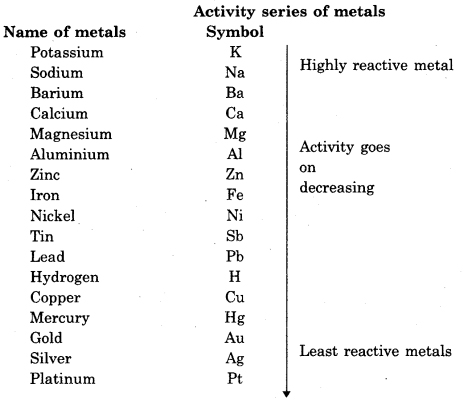
Metals which are above hydrogen are more reactive and those below hydrogen are lower in reactivity and are found in free state. In this series potassium is the most reactive metal in this series.