PSEB 10th Class Maths Solutions Chapter 13 Surface Areas and Volumes Ex 13.3 Guide
Table of Contents
Question 1. A metallic sphere of radius 4.2 cm is melted and recast into the shape of cylinder of radius 6 cm. Find the height of the cylinder.
Solution:

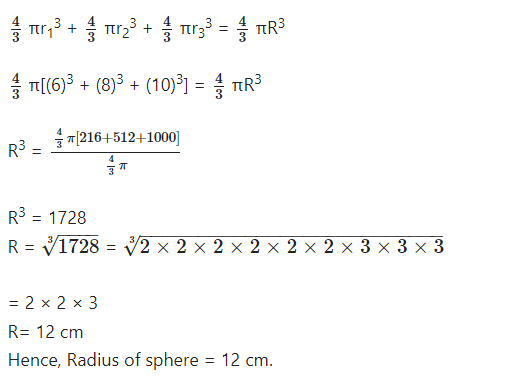
Question 2. Metallic spheres of radii 6 cm, 8 cm and 10 cm, respectively, are melted to form a single solid sphere. Find the radius of the resulting sphere.
Solution:

Radius of first sphere (r1) = 6 cm
Radius of second sphere (r2) = 8 cm
Radius of third sphere (r3) = 10 cm
Let radius of new sphere formed be R cm
On recasting volume remain same
Volume of all three spheres = Volume of big sphere
Question 3. A 20 m deep well with-diameter 7 m is dug and the earth from digging is evenly spread out to form of platform 22 m by 14 m. Find the height of the platform.
Solution:
Diameter of well = 7 m
Radius of well (cylinder) R = 7/2 m
Height of well (H) = 20 m
Length of Platform (L) =22 m
Width of Platform (B) = 14 m
Let height of Platform be H m

Volume of earth dug out from well = Volume of platform formed

Question 4. A well of diameter 3 m is dug 14 m deep. The earth taken out of ¡t has been spread evenly all around it in the shape of a circular ring of width 4 m to form an embankment. Find the height of the embankment.
Solution:
Depth of well (h) = 14 m
Radius of well (r) = 3/2 m

Embankment is in the shape of hollow cylinder whose inner radius is same as radius of well and width of embañkment 4 m
Timer radius of embankment = Radius of well(r) = 3/2 m
Outer radius of embankment (R) = (3/2 + 4) m
R = 11/2 = 5.5 m
Volume of earth dug out = Volume of embankment (so formed)
πR2h = volume of outer cylinder – volume of inner cylinder
πr2h = πR2H – πr2H
= πH[R2 – r2]

Question 5. A container shaped like a right circular cylinder having 4iameter 12 cm and height 15 cm Is full of ice-cream. The ice cream is to be filled into cones of height 12 cm and diameter 6 cm, having a hemispherical shape on the top. Find the number of such cones which can be tilled with ice-cream.
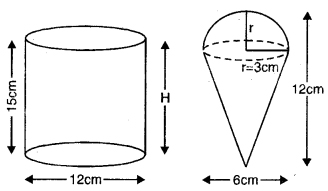
Dinieter of cvlrnder (D) = 12 cm
.. Radius of cylinder (R) = 6 cm
Height of cylinder (H) = 15 cm
Diameter of cone = 6 cm
Radius of cone (r) = 3 cm
Radius of hemisphere (r) = 3 cm
Height of cone (h) = 12 cm
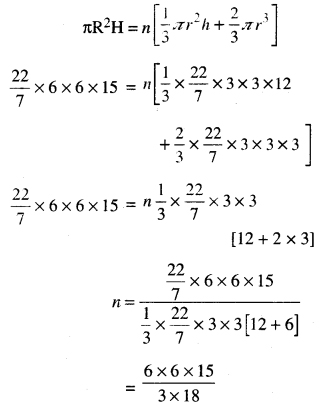
Let us suppose number of cones used to fill the ice-cream = n
Volume of ice cream in container = n [Volume of ice cream in one cone]
Question 6. How many silver coins 1.75 cm in diameter and of thickness 2 mm, must be melted to form a cuboid of dimensions 5.5 cm × 10 cm × 3.5 cm.
Solution:
Silver coin is in the form of cylinder
Diameter of silver coin = 1.75 cm
∴ Radius of silver coin (r) = 1.75/2 cm
Thickness of silver coin = Height of cylinder (H) = 2 mm

Question 7. A cylindrical bucket, 32 cm high and with radius of base 18 cm, is filled with sand. This bucket is emptied on the ground and a conical heap of sand is formed. If the height of the conical heap is 24 cm, find the radius and slant height of the heap.


Question 8. Water in a canal 6m wide and 1.5m deep is flowing with a speed of 10 km/k How much area will it irrigate in 30 minutes, If 8 cm of standing water is needed?
Solution:
Width of canal = 6 m
Depth of water in canal = 1.5 m
Velocity at which water is flowing = 10km/hr
Volume of water discharge in one hour = (Area of cross section) velocity
= (6 × 1.5m2) × 10 km
= 6 × 1.5 × 10 × 6 × 1.5 × 10 × 1000 × 1000 m3
∴ Volume of water discharge in 1/2 hour = 1/2 × 6×15/10 × 1000 = 45000 m3
Let us suppose area to be irrigate = (x) m2
According to question, 8 cm standing water is required in field
∴ Volume of water discharge by canal in 1/2 hours = Volume of water in field 45000 m3 = (Area of field) × Height of water

The PSEB 10th Class Maths Solutions for Chapter 13, Surface Areas and Volumes, Exercise 13.3, serve as a helpful guide for students to understand and solve problems related to the surface areas and volumes of combinations of solids. This exercise focuses on the concepts of combining different shapes to form composite solids and finding their surface areas and volumes.
The solutions provided in this guide are well-structured and comprehensive, enabling students to grasp the intricacies of combining solids and calculating their surface areas and volumes. The step-by-step explanations and solved examples assist students in understanding the different cases and scenarios that may arise when dealing with composite solids. By following the solutions in this guide, students can develop a strong foundation in the topic and enhance their problem-solving skills.
Additionally, the PSEB 10th Class Maths Solutions for Chapter 13, Exercise 13.3, make use of diagrams and illustrations to aid in the visualization of the composite solids. This visual representation helps students in visualizing the different components of the solids and understanding their relationships.
By utilizing these solutions, students can gain confidence in tackling complex problems involving the combination of solids. The guide presents alternative methods and techniques to approach different scenarios, enabling students to choose the most suitable method for solving a particular problem.
In conclusion, the PSEB 10th Class Maths Solutions for Chapter 13, Exercise 13.3, provide students with a comprehensive and detailed guide to understanding and solving problems related to the surface areas and volumes of composite solids. By utilizing these solutions, students can strengthen their mathematical skills and excel in their examinations.