Table of Contents
About Ch 5 Arithmetic Progressions of class 10
The PSEB solutions for Class 10 Maths Chapter 5 Arithmetic Progressions Ex 5.1 are designed to help students understand the concept of arithmetic progressions and solve related problems. These solutions cover the basics of arithmetic progressions, such as the common difference and the nth term formula. They also provide step-by-step explanations on how to find the sum of the first ‘n’ terms of an arithmetic progression. Additionally, the solutions include solved examples and practice questions to reinforce the understanding of the topic. By using these solutions, students can enhance their problem-solving skills and gain confidence in dealing with arithmetic progressions. The solutions are presented in a clear and concise manner, making it easy for students to grasp the concepts and apply them effectively in their examinations.
PSEB Solutions for Class 10 Maths Chapter 5 Arithmetic Progressions Ex 5.1
Question 1.In which of the following situations, does the list of numbers involved make an arithmetic progression, and why ?
(i) The taxi fare after each km when the fare is 15 for the first km and 8 for each additional km.
(ii) The amount of air present in a cylinder when a vacuum pump removes of the air remaining in the cylinder at a time.
(iii) The cost of digging a well after every metre of digging, when it costs 150 for the first metre and rises by 50 for each msubsequent metre.
(iv) The amount of money in the account every year when 10000 is deposited at compound interest at 8% per annum.
Solution:
(i) Let Tn denotes the taxi fare in nth km.
According to question,
T1 = 15 km;
T2 = 15 + 8 = 23;
T3 = 23 + 8 = 31
Now, T3 – T2 = 31 – 23 = 8
T2 – T1 = 23 – 15 = 8
Here, T3 – T2 = T2 – T1 = 8
∴ given situation form an AP.
(ii) Let Tn denotes amount of air present in a cylinder.
According to question,

(iii) Let Tn denotes cost of digging a well for the nth metre,
According to question,
T1 = ₹ 150; T2 = (150 + 50) = ₹ 200;
T3 = ₹ (200 + 5o) = 250 and so on
Now, T3 – T2 = ₹ (250 – 200) = 50
T2 – T1 = ₹ (200 – 150) = 50
Here, T3 – T2 = T2– T1 = 50
∴ given situation form an A.P.
(iv) Let Tn denotes amount of money in the nth year.
According to question

Question 2. Write first four terms of the AP(Airthmetic progression), when the first term a and the common difference d are given as follows:
(1) a = 10, d = 10
(ii) a = -2, d = 0
(iii) a = 4, d = -3
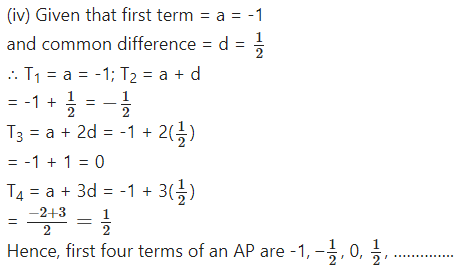
(iv) a = -1, d = 1/2
(w) a = -1.25, d = -0.25
Solution:
(i) Given that first term = a = 10
and common difference = d = 10
∴ T1 = a = 10;
T2 = a + d = 10 + 10 = 20;
T3 = a + 2d
= 10 + 2 × 10 = 10 + 20 = 30;
T4 = a + 3d = 10 + 3 × 10
= 10 + 30 = 40
Hence, first four terms of an A.P. are 10, 20, 30, 40………….
(ii) Given that first term = a = -2
and common iifference = d = 0
∴ T1 = a = -2;
T2 = a + d = -2 + 0 = -2
T3 = a + 2d = -2 + 2 × 0 = -2
T4 = a + 3d = -2 + 3 × 0 = -2
Hence, first four terms of an A.P. are -2, -2, -2, -2,…………….
(iii) Given that first term = a = 4
and common difference = d = -3
∴ T1 = a = 4;
T2= a + d = 4 – 3 = 1
T3 = a + 2d = 4 + 2(-3) = 4 – 6 = -2
T4 = a + 3d = 4 + 3(-3) = 4 – 9 = -5
Hence, first four terms of an A.P. are 4, 1, -2, -5, ……….
(v) Given that first term = a = – 1.25
and common difference = d = – 0.25
∴ T1 = a = – 1.25;
T2 = a + d = – 1.25 – 0.25 = -1.50
T3 = a + 2d = – 1.25 + 2(- 0.25)
= – 1.25 – 0.50 = – 1.75
T4 = a + 3d = – 1.25 + 3(- 0.25)
= – 1.25 – 0.75 = – 2
Hence, first four terms of an A.P. are – 1.25, – 1.50, – 1.75, – 2,
Question 3.
For the following APs, wilte the first term and the common difference:
(i) 3, 1, -1, -3, …………
(ii) 5, -1, 3, 7, ………….
(iii) 1/3,5/3,9/3,13/3, …………..
(iv) 0.6, 1.7, 2.8, 3.9, ………..
Solution:
(i) Given A.P., is 3, 1, -1, -3, ………
Here T1 = 3, T2 = 1,
T3 = -1, T4 = -3
First term = T1 = 3
Now, T2 – T1 = 1 – 3 = – 2
T3 – T2 = – 1 – 1 = -2
T4 – T3 = -3 + 1 = -2
∴ T2 – T1 = T3 – T2 = T4 – T3 = – 2
Hence, common difference = – 2 and first term = 3.
(ii) Given A.P. is – 5, – 1, 3, 7, ………….
Here T1 = – 5, T2 = – 1,
T3 = 3, T4 = 7
First term T1 = -5
Now, T2 – T1 = -1 + 5 = 4
T3– T2 = 3 + 1 = 4
T4 – T3 = 7 – 3 = 4
∴ T2 – T1 = T3 – T2 = T4 – T3 = 4
Hence, common difference = 4 and first term = – 5.

(iv) Given A.P. is 0.6, 1.7, 2.8, 3.9,…
Here, T1 = 0.6, T2 = 1.7, T3 = 2.8, T4 = 3.9
First term = T1 = 0.6
Now, T2 – T1 = 1.7 – 0.6 = 1.1
T3 – T2 = 2.8 – 1.7 = 1.1
T4 – T3 = 3.9 – 2.8 = 1.1
Hence, common difference = 1.1 and first term = 0.6.
Question 4. WhIch of the following are APs? If they form an AP(Airthmetic progression), find the common difference d and write three more terms.
(i) 2, 4, 8, 16
(ii) 2, 5/2, 3, 7/2, ………
(iii) – 1.2, – 3.2, – 5.2, – 7.2, ………….
(iv) – 10, – 6, – 2, 2, ………….
(v) 3, 3 + √2, 3 + 2√2, 3 + 3√2, ……….
(vi) 0.2, 0.22, 0.222, 0.2222, ………….
(vii) 0, -4, -8, -12, …………..
(viii) −1/2, −1/2, −1/2, −1/2, ………..
(ix) 1, 3, 9, 27 …………….
(x) a, 2a, 3a, 4a, ………………
(xi) a, a2, a3, a4, ……………….
(xii) √2, √8, √18, √32, …………
(xiii) √3, √6, √9, √12, ……………..
(xiv) 12, 32, 52, 72, ………..
(xv) 12, 52, 72, 73, ………….
Solution:
(i) Given terms are 2, 4, 8, 16 ………………
Here T1 = 2, T2 = 4, T3 = 8, T4 = 16
T2 – T1 = 4 – 2 = 2
T3 – T2 = 8 – 4 = 4
∵ T2 – T1 ≠ T3 – T2
Hence, given terms do not form an A.P.

(iii) Given terms are – 1.2, – 3.2, – 5.2, – 7.2, …………
Here T1 = – 1.2, T2 = – 3.2,
T3 = – 5.2, T4 = – 7.2
T2 – T1 = – 3.2 + 1.2 = – 2
T3 – T2 = – 5.2 + 3.2 = – 2
T 4 – T3 = – 7.2 + 5.2 = – 2
∵ T2 – T1 = T3 – T2 = T4 – T3 = – 2
∴ Common difference = d = – 2
Now, T5 = a + 4d = – 1.2 + 4(-2) = – 1.2 – 8 = – 9.2
T6 = a + 5d = – 1.2 + 5(-2) = – 1.2 – 10 = – 11.2
T7 = a + 6d = – 1.2 + 6(-2) = -1.2 – 12 = – 13.2
(iv) Given terms are – 10, – 6, – 2, 2, ………..
Here T1 = – 10,T2 = – 6
T3 = – 2, T4=2 .
T2 – T1 = – 6 + 10 = 4
T3 – T2 = – 2 + 6 =4
T4 – T3 = 2 + 2 = 4
∵ T2 – T1=T3 – T2 = T4 – T3 = 4 .
∴ Common difference = d = 4
Now, T5 = a + 4d = – 10 + 4(4) = – 10 + 16 = 6
T6 = a + 5d = – 10 + 5(4) = – 10 + 20 = 10
T7 = a + 6d = – 10 + 6(4) = – 10 + 24 = 14.
(v) Given terms are 3, 3 + √2, 3 + 2√2, 3 + 3√2, …………
Here T1 = 3, T2 = 3 + √2,
T3 = 3 + 2√2, T4= 3 + 3√2
T2 – T1 = 3 + √2 – 3 = √2
T3 – T2 = 3 + 2√2 – (3 + √2)
= 3 + 2√2 – 3 – √2 = √2
T4 – T3 = 3 + 3√2 – (3 + 2√2)
= 3 + 3√2 – 3 – 2√2 = √2
∵ T2 -T1 = T3 – T2 = T4 – T3 = √2
∴ Common difference = d = √2
Now, T5 = a + 4d = 3 + 4(√2) = 3 + 4√2
T6 = a + 5d = 3 + 5√2
T7 = a + 6d = 3 + 6√2
(vi) Given terms are 0.2, 0.22, 0.222, 0.2222, …………..
Here Here T1 = 0.2, T2 = 0.22,
T3 = 0.222, T4 = 0.2222.
T2 – T1 = 0.22 – 0.2 = 0.02
T3 – T2 = 0.222 – 0.22 = 0.002
∵ T2 – T1 ≠ T3 – T2
∴ given terms do not form an A.P.
(vii) Given terms are 0, -4, -8, -12
Here T1 = 0, T2 = -4,
T3 = -8, T4 = -12
T2 – T1 = – 4 – 0 = -4
T3 – T2= – 8 + 4 = -4
T4 – T3= – 12 + 8 = -4.
T2 – T1 = T3 – T2 = T4 – T3
∴ Common difference = d = -4
Now, T5= a + 4d = 0 + 4(-4) = -16
T6 = a + 5d = 0 + 5(-4) = -20
T7 = a + 6d = 0 + 6(-4) = -24.

(ix) Given terms are 1, 3, 9, 27
T1 = 1, T2 = 3, T3 = 9, T4 = 27
T2 – T1 = 3 1 = 2
T3 – T2 = 9 – 3 = 6.
∵ T2 – T1 ≠ T3 – T2
∴ Given terms do not form an A.P.
(x) Given terms are a, 2a, 3a, 4a, …
T1 = a, T2 = 2a, T3 = 3a, T4 = 4a
T2 – T1 = 2a – a = a
T3 – T2 = 3a – 2a = a
T4 – T3 = 4a – 3a = a
∵ T2 – T1 = T3 – T2 = T4 – T3 = a
∴ Common difference = d = a
Now T5 = a + 4d = a + 4(a) = a + 4a = 5a
T6 = a + 5d = a + 5a = 6a
T7 = a + 6d = a + 6a = 7a
(xi) Given terms are a, a2, a3, a4, …………
T1 = a, T2 = a2, T3 = a3, T4 = a4
T2 – T1 = a2 – a
T3 – T2 = a3 – a2
∵ T2 – T1 ≠ T3 – T2
∴ Given terms do not form an A.P.
(xii) Given terms are √2, √8, √18, √32, …………
T1 = √2, T2 = √8, T3 = √18, T4 = √32
or T1 = √2, T2 = 2√2 T3 = 3√2, T4 = 4√2
T2 – T1 = 2√2 – √2 = √2
T3 – T = 3√2 – 2√2 = √2
T4 – T3 = 4√2 – 3√2 = √2
∵ T2 – T1 = T3 – T2 = T4 – T3= √2
∴ Common difference = d = √2
Now, T5 = a + 4d = √2 + 4√2 = 5√2
T6 = a + 5d = √2 + 5√2 = 6√2
T7 = a + 6d = √2 + 6√2 = 7√2
(xiii) Given terms are √3, √6, √9, √12, ……………..
T1 = √3, T2= √6, T3= √9, T4= √12
or T1 = √3, T2 = √6, T3 = 3, T4 = 2√3
T4 – T1 = √6 – √3
T3 – T2 = 3 – √6
∵ T2 – T1 ≠ T3 – T2
∴Given terms do not form an A.P.
(xiv) Given terms are 12, 32, 52, 72, ………..
T1 = 12, T2 = 32, T3 = 52, T4 = 72
or T1 = 1, T2 = 9, T3 = 25, T4 = 49
T4 – T1 = 9 – 1 = 8
T3 – T2 = 25 – 9 = 16
∵ T2 – T1 ≠ T3 – T2
∴ Given terms do not form an A.P.
(xv) Given terms are 12, 52, 72, 73
T1 = 12, T2 = 52, T3 = 72, T4 = 73
or T1 = 1, T2 = 25, T3 = 49, T4 = 73
T2 – T1 = 25 – 1 = 24
T3 – T2 =49 – 24= 24
T4 – T3 = 73 – 49 = 24
∵ T2 – T1 = T3 – T2 = T4 – T3 = 24
∴ Common difference = d = 24
T5 = a + 4d = 1 + 4(24) = 1 + 96 = 97
T6 = a + 5d = 1 + 5(24) = 1 + 120 = 121
T7 = a + 6d = 1 +6(24) = 1 + 144 = 145
CONCLUSION FOR PSEB SOLUTION CLASS 10 MATH CH 5 AIRTHMETIC PROGRESSION
In conclusion, studying Chapter 5 Arithmetic Progression in the Punjab School Education Board (PSEB) Class 10th Math curriculum is highly beneficial for students. This chapter introduces students to the concept of arithmetic progression and its applications in various real-life scenarios. By understanding arithmetic progression, students develop crucial mathematical skills such as pattern recognition, problem-solving, and critical thinking. Additionally, this chapter lays the foundation for more advanced mathematical concepts and prepares students for higher-level studies in mathematics. The PSEB solution for Chapter 5 provides comprehensive explanations, examples, and practice questions, ensuring that students grasp the concepts effectively. Overall, mastering arithmetic progression in Class 10th Math not only helps students excel academically but also equips them with valuable skills that can be applied in their daily lives and future academic pursuits.
FREQUENTLY ASKED QUESTION
1 What is arithmetic progression?
Arithmetic progression (AP) is a sequence of numbers in which the difference between any two consecutive terms is constant. This constant difference is called the common difference.
2. How can arithmetic progression be represented?
Arithmetic progression can be represented in the form: a, a + d, a + 2d, a + 3d, …, where ‘a’ is the first term and ‘d’ is the common difference.
3. What is the formula to find the nth term of an arithmetic progression?
The formula to find the nth term of an arithmetic progression is:
nth term (Tn) = a + (n – 1)d, where ‘a’ is the first term, ‘n’ is the position of the term, and ‘d’ is the common difference.
4. How can we find the sum of the first ‘n’ terms of an arithmetic progression?
The sum of the first ‘n’ terms of an arithmetic progression can be calculated using the formula:
Sum (Sn) = (n/2) * [2a + (n – 1)d], where ‘a’ is the first term, ‘n’ is the number of terms, and ‘d’ is the common difference.
5. What are the applications of arithmetic progression in real life?
Arithmetic progression is used in various real-life scenarios, such as calculating interest rates, analyzing financial investments, predicting population growth, and solving problems related to time, distance, and speed.
6.How can arithmetic progression help in problem-solving?
By understanding arithmetic progression, students can identify patterns, solve problems involving missing terms or sums, and make predictions based on given information. These problem-solving skills are valuable in mathematics and other disciplines.
7. What are the benefits of studying arithmetic progression in Class 10th Math?
Studying arithmetic progression in Class 10th Math helps students develop critical thinking, problem-solving, and analytical skills. It also lays the foundation for advanced mathematical concepts and prepares students for higher-level studies in mathematics and related fields.
8.Are there any real-life examples of arithmetic progressions?
Yes, there are many real-life examples of arithmetic progressions. For instance, the growth of a tree’s height each year, the increase in salary with each promotion, and the consecutive terms of a number sequence are all examples of arithmetic progressions.