Solutions Class 10 Science Chapter 6 Life Processes Question answer
Chapter 6 of Class 10 Science, titled “Life Processes,” delves into the fundamental processes that sustain life in organisms. This chapter explores the various functions that living beings carry out to survive, grow, and reproduce. It introduces students to concepts such as nutrition, respiration, transportation, and excretion, which are essential for understanding how organisms function.
The chapter provides an in-depth understanding of the different modes of nutrition, including autotrophic and heterotrophic nutrition, and explains the significance of balanced diets. It also delves into the respiratory system, highlighting the process of breathing and the exchange of gases in organisms.
Furthermore, the chapter elucidates the intricate system of transportation in organisms, discussing the role of blood and blood vessels in transporting nutrients, gases, and waste materials. It also sheds light on excretion and the vital role played by the kidneys in removing waste products from the body.
By studying Chapter 6, students gain valuable insights into the fascinating world of life processes, equipping them with a deeper understanding of how living organisms survive and thrive.
Table of Contents
KEY POINTS TO REMEMBER
→ Visible movement is not the only defining characteristic of life.
→ Plants do not show locomotory movements, but movements occur at the molecular level.
→ Viruses are living only inside living organisms.
→ Every living organism takes food, derives energy, passes out waste material, and responds to changes within the body and environment. All these activities are collectively termed life processes.
→ These life processes are required for the maintenance of life.
→ body needs energy which is obtained from the food that the organism eats.
→ The process of acquiring oxygen from outside the body and using it in the process of breakdown of food sources for cellular needs is called respiration.
→ Aquatic animals that live in water need to use the oxygen dissolved in water.
→ Since the amount of dissolved oxygen is fairly low as compared to the amount of oxygen in the air, the rate of breathing in aquatic organisms is much faster than that of terrestrial organisms.
→ The air passing through the nostrils is filtered by fine hairs that line the nasal passage.
→ Within the lungs, the passage divides into smaller and smaller tubes which finally terminate in balloon-like structures called alveoli.
→ The blood brings carbon dioxide from the rest of the body for release into the alveoli, and the oxygen in the alveolar air is taken up by the blood in the alveolar blood vessels to be transported to all the cells in the body.
→ In human beings, the respiratory pigment is hemoglobin which has a very high affinity for oxygen.
→ If the alveolar surface were spread out, it would cover about 80 square meters.
→ The blood is a fluid connective tissue.
→ Blood consists of a fluid medium called plasma.
→ Plasma transports food, carbon dioxide, and nitrogenous wastes in dissolved form.
→ Arteries are the vessels that carry blood away from the heart to various organs of the body. Veins collect the blood from different organs and bring it back to the heart.
Science Guide for Class 10 PSEB Life Processes InText Questions and Answers
Science, English Medium, Chapter 5 -Life Processes
Question 1: Why is diffusion insufficient to meet the oxygen requirements of multicellular organisms like humans?
Answer- In multi-cellular organisms, all the cells may not be in direct contact with the surrounding environment.Thus, simple diffusion will not meet the requirements of all the cells.
Question 2: What criteria do we use to decide whether something is alive?
Answer- Living objects (organisms) have many properties like respiration, growth, reproduction, excretion etc.
Question 3: What are outside raw materials used for by an organism?
Answer- Hetrotrophs use food, water and oxygen gas from outside as raw material, But Autotrophs use carbondioxide gas, water, minerals and oxygen from outside as raw material.
Question 4: What processes would you consider essential for maintaining life?
Answer – Life processes such as nutrition, respiration, transportation, excretion, etc. are essential for maintaining life.
Question 5 : What are the differences between autotrophic nutrition and heterotrophic
nutrition?
Answer- Differences between Autotrophic and Heterotrophic nutrition
| Autotrophic Nutrition | Heterotrophic Nutrition |
| 1. It occurs in green plants and blue green algae. | 1. It occurs in animals and insectivorous plants. |
| 2. CO2 and water are raw materials which combine to form organic compound. | 2. They depend on plants and herbivore for their food. |
| 3. They need chlorophyll and sunlight | 3. There is no need of chlorophyll and sunlight, |
Question 6: Where do plants get each of the raw materials required for photosynthesis?
Answer- Plants take CO2 from the atmosphere, water is absorbed from the soil and sunlight from Sun.
Question 7: What is the role of the acid in our stomach?
Answer-In our stomach, acid (HCl) kills germs present in the food and makes the food acidic, so that pepsin
enzyme can digest protein.
Question 8: What is the function of digestive enzymes?
Answer- Digestive enzymes such as amylase, lipase, pepsin, trypsin, etc. help in the breaking down of complex food particles into simple ones.
Question 9: How is the small intestine designed to absorb digested food?
Answer- The small intestine has millions of tiny finger-like projections called villi. These villi increase the surface area for food absorption. Within these villi, many blood vessels are present that absorb the digested food and carry it to the blood stream. From the blood stream, the absorbed food is delivered to each and every cell of the body.
Question 10- What advantage over an aquatic organism does a terrestrial organism have with regard to obtaining oxygen for respiration?
Answer- Since the amount of dissolved oxygen in water is very low as compared to the amount of oxygen in the air, the rate of breathing in aquatic organisms is much faster than that seen in terrestrial organisms.
Question 11: What are the different ways in which glucose is oxidised to provide energy in various
organisms?
Answer- Glucose is first broken down in the cell cytoplasm into a three carbon molecule called pyruvate.
Pyruvate is further broken down in the following ways to provide energy:

Question 12: How is oxygen and carbon dioxide transported in human beings?
Answer- (1) Haemoglobin transports oxygen from lungs to different cells through arteries.
(2) Being more soluble in blood, carbon dioxide dissolves in blood and go from different body parts to lungs. Carbon dioxide is also transported by haemoglobin.
Question 13: How are the lungs designed in human beings to maximise the area for exchange of gases?
Answer- The exchange of gases takes place between the blood capillaries that surround the alveoli. Each lung contains 300-350 million alveoli. These numerous alveoli increase the surface area for gaseous exchange making the process of respiration more efficient.
Question 14: What are the components of the transport system in human beings? What are the functions of these components?
Answer- The main components of the transport system in human beings are the heart, blood, and blood vessels.
(1) Heart pumps oxygenated blood throughout the body. It receives deoxygenated blood from the various body parts and sends this impure blood to the lungs for oxygenation.
(2) Blood is a fluid connective tissue, it helps in the transport of oxygen, nutrients, CO2 and nitrogenous wastes.
(3) Blood vessels (arteries, veins, and capillaries) carry blood either away from the heart to various organs or from various organs back to the heart.
Question 15: Why is it necessary to separate oxygenated and deoxygenated blood in mammals and birds?
Answer- To keep body temperature normal and to fulfill high energy needs, it necessary to separate oxygenated and deoxygenated blood in mammals and birds.
Question 16: What are the components of the transport system in highly organised plants?
Answer- Xylem and phloem.
(1) Xylem conducts water and minerals obtained from the soil (via roots) to the rest of the plant.
(2) Phloem transports amino acids and food materials from the leaves to different parts of the plant body.
Question 17: How are water and minerals transported in plants?
Answer- Transpiration creates a suction pressure, as a result of which water is forced into the xylem cells of the roots. Then there is a steady movement of water from the root xylem to all the plant parts through the interconnected water – conducting channels.
Question 18: How is food transported in plants?
Answer- Phloem transports food materials from the leaves to different parts of the plant body by utilizing energy from ATP. As a result of this, the osmotic pressure in the tissue increases causing water to move into it. This pressure moves the material in the phloem to the tissues which have less pressure. This is helpful in moving materials according to the needs of the plant.
Duestion 19: Describe the structure and functioning of nephrons.
Answer- Nephrons are the basic filtering units of kidneys. Each kidney possesses large number of nephrons, approximately 1-1.5 million. The main components of the nephron are glomerulus, Bowman’s capsule, and a long renal tubule.
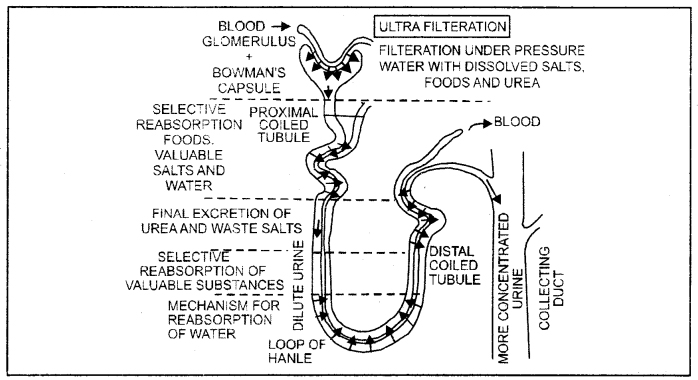
Functioning of a nephron:
(1) The water and solute are transferred to the nephron at Bowman’s capsule through with glomerulus
(2) In the proximal tubule, some substances such as amino acids, glucose, and salts are selectively
reabsorbed and unwanted molecules are added in the urine.
(3) The filtrate then moves down into the loop of Henle, where more water is absorbed.
(4) From here, the filtrate moves upwards into the distal tubule and finally to the collecting duct. Collecting duct collects urine from many nephrons.
Question 20: What are the methods used by plants to get rid of excretory products?
Answer- (1) Plants can get rid of excess water by transpiration.
(2) They can even lose some parts such as leaves.
(3) Other waste products are stored as resins and gums, especially in old xylem.
(4) Plants excrete waste gasses through stomata
Question 21: How is the amount of urine produced regulated?
Answer- The amount of urine produced depends on the amount of excess water and dissolved wastes present in
the body. Some other factors such as habitat of an organism and hormone such as Antidiuretic hormone (ADH)
also regulates the amount of urine produced.
EXERCISE QUESTION-ANSWERS
Question 1: The kidneys in human beings are a part of the system for
(a) nutrition. (b) respiration. (c) excretion. ✓ (d) transportation.
Question 2: The xylem in plants are responsible for
(a) transport of water. ✓ (b) transport of food. (c) transport of amino acids. (d) transport of oxygen.
Question 3: The autotrophic mode of nutrition requires
(a) carbon dioxide and water. (b) chlorophyll. (c) sunlight. (d) all of the above. ✓
Question 4: The breakdown of pyruvate to give carbon dioxide, water and energy takes place in
(a) cytoplasm. (b) mitochondria. ✓ (c) chloroplast. (d) nucleus.
Question 5: How are fats digested in our bodies? Where does this process take place?
Answer- Fats are present in the form of large globules in the small intestine. The small intestine gets the secretions in the form of bile juice and pancreatic juice respectively from the liver and the pancreas. The bile salts (from the liver) break down the large fat globules into smaller globules so that the pancreatic enzymes can easily act on them. This is referred to as emulsification of fats. It takes place in the small intestine.
Question 6: What is the role of saliva in the digestion of food?
Answer- Saliva makes the food soft for easy swallowing. It contains a digestive enzyme called salivary amylase, which breaks down starch into sugar.
Question 7: What are the necessary conditions for autotrophic nutrition and what are its by-products?
Answer- Autotrophic nutrition takes place through the process of photosynthesis. Carbon dioxide, water, chlorophyll pigment, and sunlight are the necessary conditions required for autotrophic nutrition. Carbohydrates (Food) and O2 are the by-products of photosynthesis.
Question 8: What are the differences between aerobic and anaerobic respiration? Name some organisms that use the anaerobic mode of respiration.
Answer
(a) Differences between aerobic and anaerobic respiration
| Aerobic respiration | Anaerobic respiration |
| 1. It takes place in the presence of oxygen. | 1. It takes place in the absence of oxygen. |
| 2. It is completed in cytoplasm and mitochondria of cells. | 2. It is completed in the cytoplasm only. |
| 3. It involves the complete oxidation of glucose into CO2 and H2O and a large amount of energy is released. | 3. It involves the incomplete oxidation of glucose into CO2 and alcohol or lactic acid and less amount of energy is released. |
| 4. The process is harmless. | 4. It is toxic to plants. |
(b) Anaerobic respiration takes place in bacteria and yeast.
Anaerobic respiration occurs in the roots of some waterlogged plants, some parasitic worms, animal muscles and some micro-organisms such as yeasts.
Question 9- How are the alveoli designed to maximize the exchange of gases?
Answer- The alveoli are the small balloon-like structures present in the lungs. The walls of the alveoli consist ofextensive network of blood vessels. Each lung contains 300−350 million alveoli. This makes large surface areafor maximize the gaseous exchange.
Question 10: What would be the consequences of a deficiency of haemoglobin in our bodies?
Answer- Deficiency of haemoglobin in blood can decrease the oxygen supply. This can lead to deficiency of oxygen in the body cells. It can also lead to a disease called anaemia.
Question 11: Describe double circulation in human beings. Why is it necessary?
Answer- Blood in the form of oxygen-rich blood and de-oxygenated blood moves through heart two times, this is known as double circulation. Oxygen rich blood from the lungs comes to the thin-walled upper chamber of the heart, the left atrium. It then contracts, while the next chamber, the left ventricle, expands, so that the blood is transferred to it. When the muscular left ventricle contracts in its turn, the blood is pumped out to the body. De-oxygenated blood comes from the body to the upper chamber, the right atrium, as it expands. As the right atrium contracts, the corresponding lower chamber, the right ventricle, dilates. This transfers blood to the right ventricle, which in turn pumps it to the lungs for oxygenation. Double circulation is necessary so that oxygen rich and de-oxygenated blood do not mix.

Question 12: What are the differences between the transport of materials in xylem and phloem?
Answer-
Differences between transport in xylem and phloem
| Transport in xylem | Transport in phloem |
| 1. Water and minerals are transported through xylem. | 1. Sucrose, amino acids and other substances are transported through phloem. |
| 2. Xylem helps in upward movement, i.e. from roots to stem, branches and leaves. | 2. Phloem is responsible for downward and lateral movement from leaves to other parts. |
Question 13: Compare the functioning of alveoli in the lungs and nephrons in the kidneys with respect to their structure and functioning,
Answer-
- Alveoli of lungs remove CO2 as a waste during exchange of gases and nephrons filter wastes from blood.
- Alveoli are supplied with extensive network of blood capillaries for gaseous exchange. Bowman’s capsule surrounds a cluster of capillaries for filtration.
- Both increases surface area either for gaseous exchange or filtration.
- Urea and uric acid wastes are removed in the nephron.
- Both purify blood lungs alveoli by removing waste gases and nephrons by filtering the waste products in the form of urine.
Multiple Choice Questions MCQ PSEB 10th Class Science
Question 1. Among the following which is a parasitic plant?
(A) Plasmodium
(B) Cuscuta
(C) Amoeba
(D) Rhizobium.
Answer:
(B) Cuscuta
Question 2. Dark reaction and light reaction of photosynthesis takes place is:
(A) stroma and grana of chioroplast respectively
(B) grana and stroma of chioroplast respectively
(C) grana only
(D) stroma only.
Answer:
(A)stroma and grana of chioroplast respectively
Question 3. Chemical reaction takes place during dark reaction of photosynthesis is:
(A) photo1ysi
(B) hydrolysis
(C) carbon dioxide is bonded with RUBP
(D) nitrogen fixation.
Answer:
(C) carbon dioxide is bonded with RUBP
Question 4. Plants are green in colour because:
(A) they absorb green light only
(B) they reflect green light
(C) they absorb green light but reflect all other lights
(D) none of the above are correct.
Answer:
(B) they reflect green light.
Question 5. The nutrition in Mucor is:
(A) parasitic
(B) autotrophic
(C) saprophytic
(D) holozoic.
Answer:
(C) saprophytic
Question 6. In amoeba the digestion is intracellular because :
(A) amoeba is unicellular
(B) amoeba is multicellular ‘
(C) amoeba is found in pond
(D) amoeba is microscopic animal.
Answer:
(A) amoeba is unicellular
Question 7. Which of the following has no digestive enzyme?
(A) Saliva
(B) Bile
(C) Gastric juice
(D) Intestinal juice.
Answer:
(B) Bile
Question 8. CO2 acceptor during dark reaction of photosynthesis is :
(A) RUBP
(B) PEP
(C) NADPH
(D) ATP.
Answer:
(A) RUBP
Very Short Answer Type Questions
Question 1. Why are maintenance processes required?
Answer: They are required to prevent breakdown.
Question 2. List three characteristics of living organisms.
Answer:
- Growth
- Movements
- Repair and maintenance of their structures.
Question 3. What are life processes?
Answer: The processes which together perform the maintenance jobs are collectively termed as life processes.
Question 4. What is the basic requirement of maintenance?
Answer: Energy is needed by living organisms for maintenance.
Question 5. What are sources of energy for living organisms?
Answer: Carbon based molecules i.e. food obtained from environment.
Question 6. List the common reactions required to obtain energy from carbon based molecules.
Answer: Oxidising-reducing reactions.
Question 7. Name any four life processes required for maintenance.
Answer:
- Nutrition
- Respiration
- Transportation
- Excretion.
Question 8. What are nutrients?
Answer: The substances which provide materials for growth, energy and maintenance are called nutrients.
Question 9. What is nutrition? Why is it necessary?
Answer: Nutrition. The sum total of processes by which living organisms obtain food materials and prepare them for use in the growth, repair and providing energy is termed nutrition.
Question 10. What is food?
Answer: Food provides energy. It Provides raw materials for growth and maintenance.
Question 11. What is holozoic nutrition?
Answer: Holozoic nutrition. When the nutrients are ingested as solid organic food matter, it is called holozoic nutrition.
Question 12. What is the source of food for heterotrophs?
Answer: All heterotrophs obtain food from autotrophs.
Question 13. Name the process which prepares food is autotrophs.
Answer: Photosynthesis.
Question 14. Why are green plants called producers?
Answer: Green plants prepare their food from CO2 and H2O in the presence of sunlight and chlorophyll. All other organisms obtain food from green plants, thus called as producers.
Question 15. Name the enzyme present in saliva.
Answer: Salivary amylase.
Question 16. In which spectrum of light maximum photosynthesis occurs?
Answer: Red light.
Question 17. Where is chlorophyll present in cells of leaves?
Answer: Chloroplast.
Question 18. How does oxygen produced during photosynthesis enter the atmosphere?
Answer: Oxygen passes out of green leaves through stomata and diffuses into the atmosphere.
Question 19. Where does photolysis occur in plant?
Answer: Photolysis occurs in chloroplasts present in the cell.
Question 20. What is the role of nitrogen plants?
Answer: Nitrogen is constituent of proteins and nitrogen bases of nucleic acids.
Question 21. What are the advantages of cooked food?
Answer: Human beings consume cooked food. Cooking makes it soft, palatable, tasty and easier to digest.
Question 22. What is the role of CO2 during photosynthesis?
Answer: CO2 provides carbon for synthesis of glucose (C6H12O8) during photosynthesis.
Question 23. What is the role of stomata in green leaves?
Answer: Stomata are minute pores through which exchange of gas occurs.
Question 24. Name the minerals obtained from soil by plants.
Answer: Nitrogen, phosphorus, potassium, iron, magnesium and other minerals.
Question 25. What is the food of Amoeba?
Answer: Food of Amoeba consists of small protozoans, algae, rotifers, bacteria, and diatoms. It also feeds upon bits of organic matter.
Short Answer Type Questions
Question 1. What are life processes?
Answer: Life processes: Every living organisms takes food, derives energy, removes wagte materials from their bodies and responds to changes in their environment. These activities are called life processes. In all living organisms there occur the basic life processes such as nutrition, respiration, transportation, excretion and reproduction, which are necessary for survival.
Question 2. What is nutrition? Briefly explain the two major kinds of nutrition.
Or
Define autotrophic nutrition.
Answer: Nutrition: All living organisms need matter to build up the body and energy to operate the metabolic reaction that sustains life. The materials which provide these two primary requirements of life are called nutrients or foods. The sum total of processes by which organisms obtain matter and energy is termed nutrition.
Modes of Nutrition:
1. Autotrophic or Holophytic nutrition: All green plants and certain protozoans (Euglena) have evolved a mechanism to directly use the energy7 of sunlight for preparing organic food in their own body from simple raw materials i.e. C02 and H20. These simple inorganic materials are transformed into glucose and oxygen is evolved.

2. Heterotrophic Nutrition: Animal, fungi, (Amoeba) and many bacteria cannot utilize solar energy. They use chemical bond-energy of organic molecules synthesized by other organisms in building their own organic molecules. Such a mode of feeding is termed as heterotrophic nutrition, and the organisms having it are called heterotrophs.
It is of three types :
- Saprophytic
- Parasitic
- Holozoic.
Question 3. Write a note on saprophytic nutrition.
Answer: Saprophytic nutrition (Sapros = rotten; phyton = plant) It this organism releases some juices to soften or digest the food and then absorbs the nutrient. Thus they decompose the dead organic matter into simpler substance. Fungi (yeast, moulds, mushrooms) and many bacteria are saprophytic in nutrition.
The saprophytic mode of nutrition can best be exemplified by the common bread mould, Rhizopus. It converts the complex organic food materials of bread i.e. starch into soluble sugars with the help of starch digesting enzymes. These soluble sugars are then absorbed by the fungus.
Question 4. Explain the two main steps of photosynthesis.
Answer: Photosynthesis occurs in two main steps.
- The first step is dependent upon light and the second step is not dependent upon light. Hence, the former is called light reaction or photochemical phase while the latter, the dark reaction or biosynthetic phase of photosynthesis.
- Water is split up during photosynthesis by the process called photolysis. It provides reductant for carbon dioxide. Oxygen is liberated. All the liberated oxygen, therefore, comes from water.
- The photolysis of water in photosynthesis was discovered by Hill and hence it is also known as Hill reaction.
- The light reaction of photosynthesis is followed by the dark reaction. In this, CO2 is first fixed by ribulose diphosphate and from this fixed CO2 phosphoglyceric acid is formed. The phosphoglyceric acid thus formed ultimately forms carbohydrates.
- The basic organic compound formed in photosynthesis is often considered to be glucose. The storage product of plants is commonly starch.
- A chemical equation of photosynthesis is

In plants and most algae it occurs in the chloroplasts i.e., light reaction and dark reaction.
Question 5. Give a brief account of factors affecting the process of photosynthesis.
Answer: Factors affecting the process of photosynthesis.
- Temperature: The rate of photosynthesis increases with increase in temperature upto a maximum of 35°C. However, the rate starts decreasing if the temperature rises beyond 30°C.
- Water: The rate of photosynthesis is slow in water-deficient conditions.
- Carbon dioxide: The rate of photosynthesis increases with an increase in carbon dioxide concentration upto a certain level, beyond which there is no effect on the rate of photosynthesis.
- Anatomy of leaf
- Chlorophyll contents.
Question 6. Write a note on lymphatic system in human beings.
Answer: Lymphatic system: The lymphatic system comprises colourless fluid, the lymph; a network of fine channels, the lymphatic capillaries; tubes of varied sizes, the lymphatic vessels; and the lymph nodes. Tissue or interstitial fluid present in the spaces between tissue cells is formed by filtration of protein-free fluid from the blood. Tissue fluid passes into lymphatic capillaries to form lymph. The latter is carried by lymphatic vessels to the veins. Lymphatic vessels have lymph nodes which filter lymph, removing microorganisms and cellular debris and adding lymphocytes.
Question 7. What is the function of epiglottis?
Answer: Epiglottis is a flap like structure present at the top of glottis. It closes glottis during swallowing of food thus checks the entry of food into respiratory passage.
Question 8. Why is food necessary for living organisms?
Answer:
Food provide energy to raw materials for growth and maintenance.
Utility of components of food.
- Carbohydrates are mainly used for producing energy.
- Fats serve as stored concentrated fuel for energy production.
- Proteins are mainly used to build up tissues.
- Mineral salts and vitamins regulate metabolic processes and growth.
- Water is essential for all biological activities.
Question 9. Explain the mechanism of breathing in human.
Answer:
Inhalation or Inspiration
- The entry of air from outside into alveoli of lungs through respiratory tract is called inhalation.
- The air enters when thoracic cavity expands due to contraction of intercostal muscles attached to ribs and peripheral muscles of the diaphragm.
- Thus the thorax moves upward, outward and forward.
- It increases the volume of thoracic cavity and the pressure decreases.
- Thus air from outside rushes into alveoli of lungs through nostrils, nasal chambers, trachea, bronchi and bronchioles.
- The alveolar sac gets filled with oxygen rich air.
Exhalation or Expiration is concerned with the expelling of carbon dioxide from lungs.
- It takes place when the volume of the thoracic cavity decreases and the pressure of the contained air in the thoracic cavity increases.
- Air passes out through the respiratory tract from the lungs.
Question 10. What is the effect of sternuos exercise on rate of breathing and why?
Answer:
Normally man breathes about 15-18 times per minute but during hard exercise the breathing rate increases to 20 to 25 times per minute. It is due to the fact that body needs more of energy thus requires more of oxygen.
Question 11. Describe the role of intestinal juice.
Answer:
Intestinal juice too is alkaline (pH 8.3).
It has many enzymes :
- Intestinal amylase hydrolyses the remaining starch and glycogen to maltose.
- Maltase changes maltose to glucose.
- Sucrase converts sucrose into glucose and fructose.
- Lactase hydrolyses lactose to glucose and fructose.
- Dipeptidases hydrolyse dipeptides to amino acids.
- Intestinal lipase splits emulsified fats into fatty acids and glycerol.
- Alkaline emulsion of digestion products formed in the small intestine is called chyle.
Question 12. Explain absorption of food in the small intestine.
Answer:
Absorption. The process of diffusion of digested food into blood present in the blood capillaries of smail intestine is called absorption. Inner lining is thrown in fold called villi. They increase surface area for absorption of food.
Glucose, amino acid, vitamins, mineral salts and water diffuses into blood present in blood capillaries of numerous villi of the small intestine. The fatty acids and glycerol diffuses into lymph present in lymph vessels called lacteals. The digested food is carried to the liver by the hepatic portal vein. The fatty acid and glycerol unite in lymph to form fat. Most of the fat passes as a milky emulsion. After absorption, the undigested- food passes into large intestine.
Question 13. State the functions of stomach and large intestine.
Functions of Stomach
Answer:
- Storage of food.
- Mechanical breakdown of food.
- Partial digestion of food.
Functions of large intestine
Colon:
- Its wall absorbs the water from undigested food.
- Absorption of digested food also takes place in this region which has not been absorbed by ileum.
Question 14. What is fermentation? How is it important?
Answer:
The slow decomposition of organic matter into simpler substances in the presence of enzymes is known as fermentation. It is a type of anaerobic respiration. Fermentation literally means a chemical change accompanied by effervescence. The anaerobic breakdown of glucose to carbon dioxide and ethanol is a form of respiration referred to fermentation. It is normally carried by yeast cells and accounts for the production of alcohol in alcoholic bevefages. In fermentation process, if glucose is converted into ethanol then it is called ethanolic fermentation. When glucose is converted into organic acids such as lactic acid, then this type of fermentation is known as lactic acid fermentation. It is carried out by the bacterium Bacillus acidilacti.
Question 15. What are the different modes of respiration in animals?
Answer:
In animals such as earthworm, respiration is by skin.
- The insects have an elaborate tracheal system of respiration.
- Fishes respire through gills.
- Respiratory system of human beings and other mammals consists of air passage or Respiratory tract, and a pair of lungs.
- Respiratory tract is made up of nasal cavity, pharynx, larynx, trachea and bronchi. The lungs are a pair of brownish grey coloured spongy structures situated in the thoracic cavity.
- The left lung consists of two lobes while the right lung consists of three lobes.
- Each lobule of a lung consists of bronchioles which terminate into a bunch of spherical thin-walled air sacs, called alveoli.
Question 16. What are parasitic nutrition?
Answer:
Parasitic nutrition (Para = besides ; sitos = food). In this an organism (parasite) depends upon the organism (host) for its nutritional requirements. Many bacteria, viruses, fungi, some non-green plants and many animals have this mode of nutrition.
For example, a fungus Puccinia is a parasite on wheat and barberry plants; Cuscuta or dodder plant grows as a parasite on many plants; tapeworms and round worms are parasites in the body of man etc.
Parasites are of two kinds :
- Ectoparasites and
- Endoparasites
Question 17. What are the functions of liver?
Answer:
Functions of liver
- Role in digestion. Bile produced by liver helps in the digestion of food as follows.
- It emulsifies the fats with its salts.
- It prevents decomposition of food by checking the growth of bacteria.
- It neutralizes the acid coming from the stomach along with food and provide alkaline medium in the intestine required for action of enzymes of pancreas and intestinal glands.
- Regulation of Blood Sugar: The liver separates the excess of sugar from the blood and stores it in its cells as glycogen (animals starch).
- Formation of Glycogen from non-carbohydrates Sources.
- Deamination: In the liver, the amino acids coming from the alimentary canal are sorted out, ammonia is formed. Ammonia is converted to less toxic urea.
- Excretion: Liver collects haemoglobin of the worn-out red blood corpuscles and changes it into bile pigments.
Question 18. What are the different ways in which glucose is oxidized to provide energy in various organisms?
Answer:
Breaking down of glucose involves two step process. In the first step, it is broken into three carbon molecule called pyruvate. The pyruvate is further broken down into energy in following different ways in various organisms :
- Aerobic Respiration: In this case, pyruvate is broken down into water and carbon dioxide along with release of energy. It commonly occurs in mitochondria of cells.
- Anaerobic Respiration in Yeast: In yeast cells during fermentation pyruvate is converted into ethanol and carbon dioxide in the absence of oxygen.
- Anaerobic Respiration in Muscles: Due to lack of oxygen, e.g. during vigorous running or exercise, in human muscles, pyruvate is converted into lactic acid.
Question 19. What are
(i) stomata and
Answer:
Stomata are tiny apertures found on the surface of the leaf, which regulate the exchange of respiratory gases and transpiration.
(ii) lenticels?
Answer:
Lenticels are the raised pores in the woody plants that allow the exchange of gases between the atmosphere and the internal tissues.
Question 20. Briefly explain breathing, external resperation exchange of gases and tissue resperation.
Answer:
- Breathing involves inhaling of oxygen rich fresh air and exhaling of carbon dioxide rich foul air. The respiratory surface is richly supplied with blood for this purpose. Oxygen of the inhaled air is taken up by blood while carbon dioxide of the blood passes into the air for exhalation.
- The exchange of gases between the blood and the air at the respiratory surface is. known as external respiration.
- Oxygen absorbed by the blood at the respiratory surface is taken to various parts of the body through arteries. Blood loses the oxygen contained in it to tissue fluid, from where it picks up carbon dioxide. The latter is brought to the respiratory surface by blood.
- Tissue respiration, also called internal respiration, is the exchange of gases between the tissue cells and the blood involving uptake of oxygen by tissue cells, oxidation of respiratory substrate and elimination of carbon dioxide by the cells.
Question 21. Why are WBCs called ‘soldiers of the body’?
Answer:
WBC (White Blood Corpuscles) or leucocytes engulf and destroy the foreign particles in the body. Hence they are called ‘soldiers of the body.’
Question 22. What are hypertension and hypotension?
Answer:
Hypertension. It is the high blood pressure which is caused due to emotions such as worry, excitement, fear etc.
Hypotension. It is the low blood pressure when it falls below the normal level.
Question 23. Write a note on lymphatic system in human beings.
Answer:
Lymphatic system: The lymphatic system comprises colourless fluid, the lymph; a network of fine channels, the lymphatic capillaries; tubes of varied sizes, the lymphatic vessels; and the lymph nodes. Tissue or interstitial fluid present in the spaces between tissue cells is formed by filtration of protein-free fluid from the blood. Tissue fluid passes into lymphatic capillaries to form lymph. The latter is carried by lymphatic vessels to the veins. Lymphatic vessels have lymph nodes which filter lymph, removing microorganisms and cellular debris and adding lymphocytes.
Question 24. Write functions of lymph.
Answer:
Functions of lymph
- It drains excess tissue fluid from the extracellular spaces back into the blood.
- Some of the fluid from the digestive tract is absorbed in the lymph. The lymphatic vessels store this fluid temporarily, and release it gradually so that the kidneys do not face a sudden pressure of urine excretion.
- It carries carbon dioxide and nitrogenous waste materials that diffuse into the tissue fluid to the blood.
- It takes lymphocytes and antibodies from the lymph nodes to the blood.
Question 25. Write a short note on root pressure.
Answer:
Root pressure: During absorption, water is forced into the xylem vessels by the surrounding cortical cells with a certain force. This induces a pressure which is responsible for ascent of sap to many feet in xylem. This pressure which is developed due to the activity of root is called as root pressure.
Root pressure is a vital phenomenon and depends upon the activity of living root cells. The magnitude of root pressure varies from 2-8 atm.
Question 26. How is transpiration useful to plants?
Answer:
Advantages of transpiration
- It has cooling effect on the plants as excess of sun’s energy is dissipated.
- It helps in the removal of excess of water from the plant.
- It causes ascent of sap.
- It helps to maintain water cycle.
- It increases the amount of sugar and mineral content in the fruit.
- It is needed to permit photosynthesis to take place.
Question 27. What is translocation?
Answer:
Translocation: The long distance transport of the organic food from a source to a sink is known as translocation.
Question 28. Briefly describe excretory system.
Answer:
- Kidneys are a pair of bean-shaped reddish brown organs which lie in the lumbar part of abdomen along the dorsal wall, one on either side of the vertebral column.
- Each kidney receives a renal artery from dorsal aorta and sends a renal vein to inferior vena cava.
- The excretory waste products ,are filtered out in the kidney.
- Each kidney contains about 1.2 million excretory units called uriniferous tubules or nephrons.
- Uriniferous tubule is a long, twisted, narrow, tubular structure which consists of ‘ Bowman’s capsule, neck, proximal convoluted tubule, loop of Henle and distal convoluted tubule.
- Bowman’s capsule is a blind cup-shaped end of uriniferous tubule with a tuft of blood capillaries called glomerulus.
- Ureters are two distensible tubes which connect the kidneys with the urinary bladder.
- Urinary bladder is a median pear-shaped bag-like structure that occurs in she pelvic region of abdominal cavity.
- Urinary bladder can hold 300-800 ml of urine.
- Urethra is a tubular connection between the urinary bladder and the external Opening of urinary tract.
Question 29. State one main function of the following :
(i) Glomerulus
Answer:
The filtration of blood in the nephron takes place in the glomerulus.
(ii) Malpighian capsule
Answer:
Malpighian capsule is concerned with ultrafiltration.
(iii) Sweat gland
Answer:
Sweat glands produce sweat containing urea, uric acid and salts. Sweat evaporates to bring down the body temperature to normal.
(iv) Nephron of kidney tubule
Answer:
Through the kidney tubule or nephrons, filtration of urea, uric acid, water and some salts occur from the blood.
(v) Loop of Henle.
Answer:
Loop of Henle is useful in the absorption of water and secretion of urea.
Question 30. Name the chief organs of excretion in man. Mention the waste products that they excrete.
Answer:
The chief excretory organs and the waste products removed by them are :
- Kidneys – Urea in the form of urine.
- Lungs – Carbon dioxide.
- Skin – Water and salts as sweat.
Question 32. Name the following :
(i) The structure that brings urine from the kidney to the urinary bladder.
Answer:
Ureter
(ii) Thin membranous sac serving as the reservoir of urine.
Answer:
Urinary bladder
(iii) Any two organic constituents of normal human urine.
Answer:
Urea, creatinine
(iv) The chief nitrogenous waste product in the human urine and the organ which produces it.
Answer:
Urea, liver
(v) Name two excretory products formed by the liver.
Answer:
Bile pigments (Bilirubin, Biliverdin), urea.
Difference Between Based Question of 10th science Chapter Life Process
Question 1. How is respiration different from breathing?
Answer:
Differences between Breathing and Respiration
| Breathing | Respiration |
| 1. It is ventilation or bringing in of oxygenated air and giving out deoxygenated air. | 1. Respiration of animals includes breathing, gaseous exchange and catabolic breakdown of food. |
| 2. It is a physical process. | 2. Respiration is both a physical and physiological process. |
| 3. Breathing does not liberate energy. | 3. It liberates energy. |
| 4. It is restricted to organs where gaseous exchange occurs between blood and atmospheric air. | 4. Respiration involves every living ceil of the |
Question 2. List three differences between respiration in plants and respiration in animals.
Answer:
Differences in respiration in plants and animals
| Respiration in plants | Respiration in animals |
| 1. All the cells of plant parts (root, stem, leaves) perform the respiration individually. | 1. It is performed by specific respiratory organs for all the cells of body. |
| 2. There is little transport of gases from one part to the other. | 2. Transport of gases is maximum. |
| 3. Rate of respiration is low. | 3. Rate of respiration is high. |
Question 3. Differentiate the following :
Respiration and Photosynthesis
Answer:
Differences between Respiration and Photosynthesis
| Respiration | Photosynthesis |
| 1. It is a catabolic process in which food substrates are broken down. | 1. It is an anabolic process in which food substrates are synthesized. |
| 2. It takes place in all living cells. | 2. It is carried out only by the chlorophyll containing cells of plants. |
| 3. CO2 and H2O are produced. | 3. CO2 and H2O are used. |
| 4. CO2 is given out. | 4. O2 is released as a byproduct. |
| 5. Chemical energy is converted into ATP and some energy is lost as heat. | 5. Radiant energy’of light is converted into 1 chemical energy. |
Question 4. Differentiate between respiration and combustion.
Answer:
Difference between respiration and combustion.
| Respiration | Combustion |
| 1. It occurs in living cells. | 1. It occurs in non living and dead cells. |
| 2. It is a complex biochemical process controlled by several enzymes. | 2. It is a chemical process. |
| 3. Heat produced is much less. | 3. A large amount of heat is produced. |
| 4. There is no flame or light produced. | 4. This process is usually accompanied with flame and light. |
Question 5. Differentiate between Light reaction and Dark reaction in photosynthesis.
Answer:
Difference between light reaction and Dark reaction
| Light reaction | Dark reaction |
| 1. Light reaction is light induced chemical reaction. | 1. Dark reaction requires no light and is purely enzyme controlled reaction. |
| 2. Energy rich compounds like ATP and NADPH2 are synthesized. | 2. The energy rich compounds are used to produce the organic compounds. |
| 3. Oxygen is liberated. | 3. No liberation of oxygen. |
| 4. It takes place in the grana of the chloroplasts. | 4. It takes place in the stroma of chloroplasts. |
Question 6. Differentiate between Saprophytic and Parasitic nutrition.
Answer:
| Saprotrophic Nutrition | Parasitic nutrition |
| Many organisms absorb fluid food through the body surface. This is called saprotrophic nutrition. Bacteria and fungi flourish on dead, decaying organic matter of both plant and animal origin. They secrete digestive enzymes onto this matter. The enzymes hydrolyze the organic matter into simple soluble products that are then absorbed. This method of taking up organic food is known as saprophytic nutrition. | The organisms obtain nutrients from a living host without helping it any way. Examples. Liver fluke lives in the bile duct of sheep and absorbs nutrient. Other examples include several fungi, bacteria and a few higher non-green plants such a cuscuta. |
Question 7. What is a digestive gland? Name the various digestive glands of man and their secretions.
Answer:
Digestive gland. A gland that secretes digestive juice which is helpful in the digestion of food is called a digestive gland.
Digestive glands of Man
| Name of digestive gland | Name of digestive juice/Secretion |
| 1. Salivary gland | Saliva |
| 2. Gastric glands | Gastric juice |
| 3. Pancreas | Pancreatic juice |
| 4. Liver | Bile |
| 5. Intestinal glands | Intestinal juice |
Question 8. Write the enzymes of the pancreatic juice, the substrates they digest and the products of their digestive action.
Answer:
Enzymes of the pancreatic juice
| Name of Enzyme | Substrate | Name of end products |
| 1. Amylase | Starch, glycogen | Maltose and Isomaltose |
| 2. Trypsin | Proteoses, Peptones and Proteins | Peptides and amino acid |
| 3. Lipase | Emulsified lipids | Glycerol and fatty acids |
Question 9. State differences between artery and vein.
Answer:
Differences between Artery and Vein
| Artery | Vein |
| 1. An artery carries blood from the heart to different organs of the body. | 1. A vein collects blood from different organs of the body and brings it back to the heart. |
| 2. Blood flows under great pressure. | 2. Blood flows under less pressure. |
| 3. It has a thick muscular wall. | 3. Wall is thin |
| 4. It is non collapsible. | 4. It is collapsible. |
| 5. It contains oxygenated blood (Exception pulmonary artery). | 5. It contains deoxygenated blood (Exception pulmonary vein) |
| 6. Valves are absent. | 6. Valves are present. |
| 7. Mostly deep seated. | 7. Mostly superficial. |
Question 10. Give differences between blood and lymph.
Answer:
Differences between Blood and Lymph
| Blood | Lymph |
| 1. It consists of plasma, erythrocytes, leucocytes and platelets. | 1. It consists of plasma and leucocytes (lymphocytes most abundant). |
| 2. It is red in colour due to the presence of haemoglobin in erythrocytes. | 2. It is colourless as haemoglobin is absent, |
| 3. Its plasma has more proteins, calcium and phosphorus. | 3. Its plasma has fewer proteins and less calcium and phosphorus. |
| 4. It transports materials in the body. | 4. It acts as middle man between blood and body tissue. |
Question 11. Difference between the followings :
(i) Autotrophic and Heterotrophic nutrition
(ii) Herbivore and Carnivore.
Answer:
(i) Autotrophic and Heterotrophic nutrition :
| Autotrophic Nutrition | Heterotrophic Nutrition |
| 1. Food is self-manufactured. | 1. Food is obtained readymade from outside. |
| 2. An external source of energy is required for synthesis of food. | 2. An external source of energy is not required. The required energy is present in the food obtained from outside. |
| 3. Inorganic substances constitute the raw materials for manufacturing food. | 3. Inorganic substances are not much required. |
| 4. Chlorophyll is present for trapping light energy. | 4. Chlorophyll is absent |
| 5. Digestion is absent. | 5. An external or internal digestion is required for conversion of complex organic materials into simpler and soluble ones. |
| 6. Organisms performing autotrophic nutrition function as producers. Examples: Green plants, some bacteria, some protists. | 6. Organisms performing heterotrophic nutrition function as consumers. Animals, many protists and monerans. |
ii) Herbivore and Carnivore
| Herbivore | Carnivore |
| Animals winch cat only plants. e.g. Cow, goat etc. | They feed on flesh of other animals, e.g. Lion, vulture etc. |
Question 12. Name the constituents of blood and state the functions of each.
Answer:
| Constituents | Functions |
| 1. Plasma, (i) Serum | It contains proteins as well as organic and inorganic substances in solution. |
| (ii) Fibrinogen | It serves to carry the nutritive and waste materials, antibodies, enzymes and hormones. |
| 2. Red blood corpuscles (R.B.Cs.) | Clotting of blood. |
| (Erythrocytes) | They help to transport oxygen. |
| 3. White blood corpuscles (W.B.Cs) | They help to defend our body against bacteria, as well as the toxins which these organisms may produce. They also help to remove useless dead tissues from the blood. |
| 4. Blood Platelets or Thrombocytes | They play a vey important role in bringing about the coagulation of blood. |